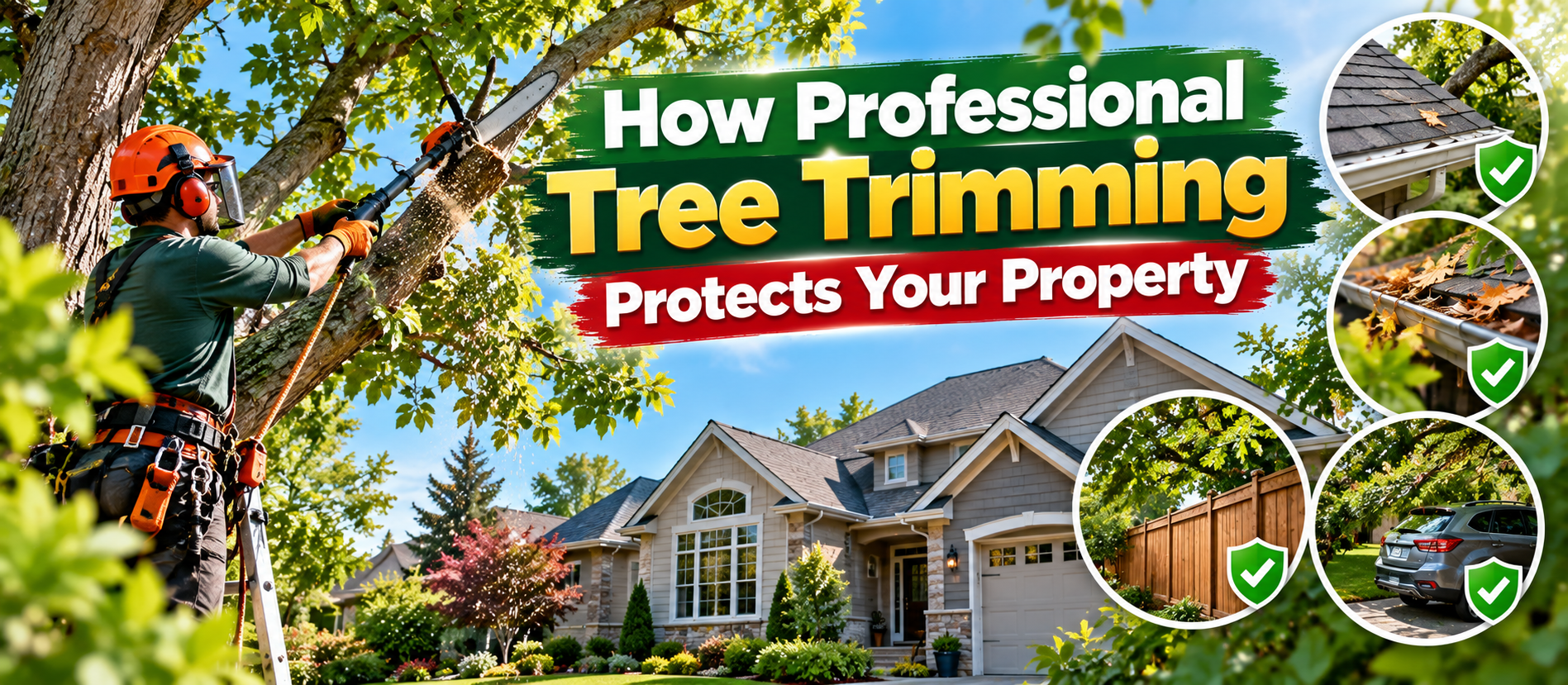
📋 Quick Summary
In this article:
Why Tree Trimming Matters for Property Protection
1. Protects Your Roof From Falling Branches
2. Reduces the Risk of Damage to Vehicles
3. Helps Protect Gutters and Drainage Systems
4. Protects Windows, Siding, and Exterior Walls
5. Helps Prevent Damage From Weak and Dead Branches
6. Improves Clearance Around Walkways and Driveways
7. Reduces Tree-Related Storm Risks
8. Protects Fences, Decks, Patios, and Outdoor Structures
9. Protects Landscaping and Garden Areas
10. Helps Keep Utility Areas Safer
11. Reduces the Need for Emergency Tree Work
Trees add beauty, shade, privacy, and character to a property. They can also become a serious source of risk when branches grow too close to buildings, become weak, or are damaged by storms, disease, or poor pruning. Professional tree trimming helps control these risks while supporting healthier and safer trees.
Tree trimming is not simply about cutting branches. Good pruning is a planned process. A professional evaluates the tree, identifies weak or hazardous growth, considers nearby structures, and removes selected branches without unnecessarily damaging the tree. Proper pruning can reduce the chance of falling limbs, improve clearance around buildings and utilities, and help a tree maintain a strong structure.
This guide explains how professional tree trimming protects your property, what warning signs homeowners should watch for, when trimming is necessary, how the process works, and how to choose a qualified tree-care professional.
Why Tree Trimming Matters for Property Protection
A mature tree can have large branches extending over roofs, driveways, patios, fences, walkways, parked vehicles, and utility lines. If a weak branch fails, the damage can be expensive. A falling limb may break roof shingles, damage gutters, scratch vehicles, destroy fencing, block access, or injure people.
Professional pruning focuses on reducing these risks before a failure occurs. Tree-care guidance recommends removing dead branches and addressing weak or poorly positioned limbs that overhang homes, parking areas, sidewalks, and other locations where falling branches could cause injury or property damage.
The goal is not to remove every branch near a structure. The goal is to understand the tree's structure and manage the branches that create an unacceptable level of risk.
1. Protects Your Roof From Falling Branches
Your roof is one of the most important parts of your home, but it can also be one of the most exposed to nearby trees. Branches that hang directly over a roof can scrape roofing materials during windy conditions. Dead limbs can fall during storms. Heavy branches may also drop leaves, twigs, and other debris into gutters.
Professional tree trimming can create appropriate clearance between the tree canopy and the roof. It can also remove dead, broken, or structurally weak branches that could fall toward the house.
This does not mean a tree should automatically be cut back aggressively. Excessive pruning can weaken a tree and create new problems. A professional should determine which branches need to be removed and how much live growth can be safely pruned.
2. Reduces the Risk of Damage to Vehicles
Driveways and parking spaces are common targets beneath mature trees. A branch that looks harmless during calm weather may become a hazard when strong wind, heavy rain, or another weather event puts stress on it.
Professional pruning can reduce overhanging limbs and improve clearance above parking areas. It can also identify branches with cracks, weak attachment points, decay, or excessive weight.
Keeping trees properly managed around parking spaces is especially useful when a property has several mature trees or when vehicles are regularly parked below the canopy.
3. Helps Protect Gutters and Drainage Systems
Tree branches close to roofs can contribute to a steady buildup of leaves, twigs, seeds, and other organic debris in gutters. Clogged gutters can interfere with normal drainage and may contribute to water spilling near exterior walls or foundations.
Trimming branches away from the roofline can help reduce the amount of debris entering the gutter system. It does not eliminate gutter cleaning, but it can make ongoing maintenance easier.
Professional tree trimming is therefore part of a wider property-maintenance strategy. Trees, gutters, roofs, drainage, and landscaping should be considered together rather than as completely separate systems.
4. Protects Windows, Siding, and Exterior Walls
Branches that repeatedly rub against a building can damage exterior surfaces over time. Small twigs may scratch siding or windows. Larger branches can strike walls during storms. Dense vegetation near a building can also make inspection and maintenance more difficult.
Strategic pruning can improve clearance around windows, walls, exterior equipment, and other vulnerable surfaces. This can help reduce physical contact and make it easier to inspect the building envelope.
5. Helps Prevent Damage From Weak and Dead Branches
Dead branches are among the clearest reasons to schedule professional tree trimming. A dead limb has no living tissue supporting new growth, and its condition can deteriorate over time.
Weak branches can also develop from poor attachment angles, previous storm damage, cracks, decay, or excessive weight. Some defects are easy to see, while others require professional assessment.
Tree risk guidance from the International Society of Arboriculture notes that pruning defective branches can be one option for reducing tree-related risk, while also warning that inappropriate pruning can weaken a tree.
6. Improves Clearance Around Walkways and Driveways
Low branches can interfere with people walking through a property, vehicles entering a driveway, or maintenance equipment moving around the yard. A branch may not be dangerous enough to fall, but it can still create an everyday safety problem.
Professional trimming can improve clearance over paths and access points while preserving the tree's natural form. This is particularly helpful for properties with children, older adults, frequent visitors, delivery access, or busy driveways.
7. Reduces Tree-Related Storm Risks
Storms can turn existing tree defects into sudden hazards. Wind can place heavy loads on branches. Saturated soil can reduce root stability. Lightning can split trees or damage major stems. A previously weakened branch may fail when the weather changes.
Routine tree care gives homeowners an opportunity to identify problems before severe weather arrives. An arborist may recommend pruning, support systems, moving a potential target, routine care, or tree removal depending on the level and type of risk.
Trimming cannot guarantee that a tree will never fail. It is a risk-management measure, not a promise of complete protection.
8. Protects Fences, Decks, Patios, and Outdoor Structures
Trees often grow close to fences, decks, sheds, pergolas, gazebos, outdoor kitchens, and other landscape structures. Over time, branches may extend above these areas.
Professional pruning can reduce the likelihood of branches striking these structures. It can also improve visibility and access for maintenance teams.
For valuable outdoor structures, it is better to manage tree growth proactively than to wait until a branch causes damage.
9. Protects Landscaping and Garden Areas
Tree trimming can also protect plants and landscaping below the canopy. Excessive shade may prevent some plants from growing well. Heavy branches can crush shrubs and garden beds if they fail.
However, shade is not always a problem. Many landscape plants are selected specifically for low-light conditions. A professional should consider the tree and the surrounding landscape before removing significant live branches.
10. Helps Keep Utility Areas Safer
Branches growing near electrical lines create a serious hazard. Tree limbs can contact power lines or fall onto them during storms. The resulting event may cause injury, fire, outages, or property damage.
Homeowners should not attempt to trim branches that are near energized electrical lines. OSHA guidance identifies power lines as a major tree-care hazard and recommends that overhead lines be treated as energized. Line-clearance work requires trained personnel and appropriate safety procedures.
If a tree or branch is touching a power line, keep away from the area and contact the appropriate utility provider or qualified tree-care service. Never assume that a line is safe because the power appears to be off.
11. Reduces the Need for Emergency Tree Work
Emergency tree removal and storm cleanup can be stressful and expensive. A fallen tree may block a driveway, damage a roof, break a fence, or create a dangerous situation around utility lines.
⚠ Watch Out
Routine inspection and pruning can address some defects before they become emergencies. It cannot prevent every storm-related failure, but proactive maintenance can reduce avoidable hazards.
Regular tree care is especially important for mature trees located close to homes, public walkways, garages, parking areas, and other high-value targets.
12. Supports Stronger Tree Structure
Professional pruning is also about long-term tree structure. A tree with poor branch distribution may develop weak unions or excessive weight on one side. Selective pruning can help manage competing branches and improve the overall structure.
The correct pruning method depends on the species, age, condition, location, and purpose of the tree. A mature shade tree should not be treated like a small ornamental shrub.
13. Helps Trees Maintain Their Natural Shape
Good pruning should normally look natural after the work is finished. The objective is not to make every tree look perfectly symmetrical.
Over-pruning can remove too much leaf-producing material. It can also expose branches and stems to conditions they were not previously adapted to handle. Professional tree trimming focuses on selective cuts rather than unnecessary removal.
14. Prevents Problems Caused by Poor DIY Trimming
DIY tree trimming can look simple when the branches are small and reachable. Problems become much more serious when the tree is tall, the branches are heavy, or the work is near a building or utility line.
Incorrect cuts can leave large wounds, remove too much live canopy, damage branch collars, or encourage weak regrowth. A falling branch can also injure the person doing the work or damage nearby property.
Tree-care professionals use proper equipment, climbing methods, cutting techniques, and work-zone planning. OSHA identifies falls, falling branches, equipment hazards, and electrical contact as significant risks in tree-care work.
Signs Your Property May Need Professional Tree Trimming
Consider a professional tree assessment if you notice:
- Dead branches in the canopy
- Large broken or hanging limbs
- Branches touching the roof
- Branches rubbing against windows or walls
- Low branches blocking walkways or driveways
- Branches growing toward utility lines
- Visible cracks in major limbs
- Weak or narrow branch attachments
- Heavy growth concentrated on one side
- Storm-damaged branches
- Branches blocking streetlights, signs, or visibility
- A tree leaning toward a structure
- Sudden changes in leaf condition or tree health
Some defects are difficult to evaluate from the ground. If you are unsure about the seriousness of a problem, a qualified arborist can assess the tree and recommend appropriate action.
Professional Tree Trimming vs. Tree Removal
Tree trimming and tree removal are not the same service. Trimming is intended to manage branches and reduce specific risks while keeping the tree in place. Removal is considered when a tree is dead, severely damaged, structurally unsafe, or presents a level of risk that cannot reasonably be managed through pruning or other measures.
Tree risk guidance recommends considering options such as pruning, moving potential targets, supporting weak structures, routine care, or removal depending on the situation.
A good tree-care professional should explain why a particular action is recommended rather than automatically suggesting removal.
What Happens During a Professional Tree Trimming Visit?
A typical professional service may include several steps.
1. Property and Tree Inspection
The professional evaluates the tree, nearby structures, access routes, utility lines, visible defects, and potential targets below the canopy.
2. Risk Identification
The team identifies dead limbs, broken branches, weak attachments, excessive growth, clearance problems, and other conditions that may require attention.
3. Pruning Plan
The professional determines which branches should be removed and how the cuts should support the tree's structure and the property's safety needs.
4. Safe Work-Zone Setup
Equipment, drop zones, pedestrian areas, vehicles, and nearby structures should be considered before cutting begins. Professional tree care requires careful planning because falling branches and equipment can create hazards.
5. Selective Pruning
Branches are removed using appropriate cuts and equipment. The goal is controlled pruning rather than excessive cutting.
6. Cleanup
Branches, leaves, and wood debris are removed according to the agreed scope of work. A written contract should clearly identify cleanup and disposal responsibilities.
How Often Should Trees Be Trimmed?
There is no single schedule that works for every tree. Species, age, growth rate, location, health, previous pruning, and local weather conditions all matter.
Instead of trimming a tree simply because a calendar says it is time, homeowners should use a combination of routine inspection and professional recommendations. Young trees may need structural pruning as they develop. Mature trees may need selective maintenance based on growth and risk.
After major storms, a professional inspection can be useful even when the tree appears normal from the ground. Hidden cracks or broken branches may not be obvious.
Best Practices for Protecting Property With Tree Trimming
- Inspect mature trees regularly.
- Remove dead and hazardous branches before they fail.
- Maintain sensible clearance from roofs and structures.
- Keep walkways and driveways clear of low branches.
- Monitor trees near parked vehicles.
- Do not prune near electrical lines yourself.
- Use qualified professionals for tall or complex trees.
- Avoid excessive pruning and unnecessary topping.
- Inspect trees after major storms.
- Keep written records of major tree-care work.
- Ask for proof of appropriate insurance before hiring a contractor.
- Get the scope of work, cleanup, disposal, and price in writing.
How to Choose a Professional Tree Trimming Company
Choosing the cheapest contractor is not always the safest option. Tree work involves heavy branches, specialized equipment, heights, and potential property damage. A reliable provider should be able to explain the proposed work clearly.
Ask the company:
- Are you insured for liability and property damage?
- Do you carry appropriate worker coverage?
- Who will perform the tree assessment?
- What branches are you recommending for removal?
- Why does each major cut need to be made?
- How will you protect my roof, vehicles, landscaping, and other structures?
- How will you handle branches and debris?
- Do you work near utility lines, and if so, who handles line-clearance work?
- Will you provide a written estimate?
- What happens if additional hazards are discovered during the job?
Extension guidance recommends checking insurance and getting a written contract that clearly describes tasks, costs, labor, cleanup, disposal, and other important terms.
Why Professional Tree Trimming Can Save Money
Professional trimming has an upfront cost, but preventive maintenance can be less expensive than repairing avoidable damage. A single fallen limb can damage roofing, siding, windows, fencing, vehicles, or outdoor structures.
Good pruning may also make future tree maintenance easier by addressing structural problems before branches become larger and more difficult to manage.
The financial value of tree trimming should therefore be considered as part of property risk management. The objective is not to remove as many branches as possible. It is to reduce meaningful risks while preserving a healthy tree.
Common Tree Trimming Mistakes Homeowners Should Avoid
Over-Pruning
Removing too much canopy can stress a tree and reduce its ability to produce energy. Pruning should be selective.
Topping
Cutting major limbs back to stubs can create weak regrowth and long-term structural problems. It should not be treated as a normal maintenance method.
Ignoring Dead Branches
Dead branches do not become safer simply because they have been present for a long time. They should be assessed and removed when appropriate.
Cutting Near Power Lines
This is one of the most dangerous mistakes. Do not attempt electrical-line clearance yourself. Use the appropriate utility and qualified tree-care professionals.
Using the Wrong Equipment
Ladders, chainsaws, ropes, and other equipment can become dangerous when used without proper training. Height and branch weight can turn a small mistake into a serious accident.
Tree Trimming and Property Value
Well-maintained trees can contribute to a property's appearance and outdoor usability. A healthy, well-structured canopy can frame a home, provide shade, and make outdoor areas more comfortable.
Property value should not be reduced to appearance alone. A tree that is attractive but structurally hazardous can become a liability. Professional maintenance helps balance visual appeal, tree health, and property safety.
Tree Trimming After Storm Damage
After severe weather, do not rush toward a damaged tree. Look for hanging branches, split limbs, leaning trees, damaged roots, and contact with electrical lines.
If a tree is touching a power line, stay away and contact the appropriate utility provider. Tree-care organizations also recommend resisting the urge to handle serious storm damage yourself and seeking qualified professional help.
Storm-damaged trees can behave unpredictably. A branch that appears stable may move or fall when another part of the tree is cut.
Seasonal Tree Trimming Considerations
Pruning needs vary by tree species and local climate. Some pruning may be best scheduled during dormant periods, while urgent safety work should be addressed when necessary.
Do not postpone removal of an obviously dangerous branch simply because it is not the preferred pruning season. Safety concerns should be evaluated separately from routine cosmetic maintenance.
Quick Property Protection Checklist
- Check trees near the house.
- Look for dead, broken, or hanging branches.
- Check clearance above the roof.
- Inspect branches above parked vehicles.
- Keep walkways and driveways clear.
- Watch for branches near electrical lines.
- Inspect trees after storms.
- Schedule professional assessment for large or complex trees.
- Keep tree-care work documented.
- Use insured, qualified professionals for hazardous work.
Frequently Asked Questions About Professional Tree Trimming
Does professional tree trimming prevent all tree-related property damage?
No. Pruning can reduce specific risks, but it cannot guarantee that a tree will never fail. Severe storms, root problems, disease, lightning, and unexpected structural failure can still cause damage.
Can I trim a tree myself?
Small, reachable branches may sometimes be handled by homeowners using appropriate methods. However, large trees, heavy branches, work near structures, and work near utility lines should be handled by trained professionals.
Should branches touching my roof be removed?
They should be assessed. Some branches may need selective pruning to improve clearance, while others may not require removal. A professional can determine the safest approach.
How do I know if a branch is dangerous?
Dead wood, cracks, broken attachments, hanging limbs, decay, and large branches over important targets can indicate elevated risk. A professional assessment is recommended when the condition is unclear.
Is tree trimming the same as tree topping?
No. Proper pruning removes selected branches for a specific purpose. Topping involves cutting major stems or limbs back severely and can create structural problems. It should not be considered routine tree maintenance.
Should I trim a tree after a storm?
Damaged trees should be assessed promptly, especially when branches are hanging over buildings, vehicles, walkways, or utility lines. Do not approach or cut trees involved with power lines.
What should a tree trimming estimate include?
A written estimate should describe the trees and branches involved, work to be performed, price, cleanup, disposal, access requirements, and any important exclusions or conditions.
How can professional tree trimming protect my home?
It can reduce the presence of dead and defective branches, improve clearance around structures, manage branches over roofs and vehicles, and address specific tree-related hazards before they become emergencies.
Final Thoughts
Professional tree trimming protects your property by managing tree-related risks before they become expensive problems. The best approach is not aggressive cutting. It is careful assessment, selective pruning, proper safety procedures, and ongoing tree care.
Homeowners should pay close attention to trees growing near roofs, garages, driveways, walkways, fences, vehicles, outdoor structures, and utility lines. Dead branches, storm damage, cracks, weak attachments, and excessive growth deserve professional attention.
When tree work is complex or hazardous, hiring a qualified tree-care professional is a smart property-protection decision. A well-maintained tree can remain a valuable part of the landscape while presenting less avoidable risk to the people and structures around it.
For more practical digital marketing, home-service, and business content, visit Digiifrog at www.digiifrog.com.
Sources and Reference Guidance
- University of Minnesota Extension – Pruning Trees and Shrubs
- TreesAreGood / International Society of Arboriculture – Managing Hazards and Risk
- OSHA – Tree Trimming & Removal Safety
- OSHA – Solutions for Tree Care Hazards
- University of Minnesota Extension – How to Hire a Tree Care Professional
Ready to Grow?
Talk to us about a strategy tailored to your brand — we will help you stand out in search, AI discovery and social.
Comments (0)
Log in to leave a comment.