📋 Quick Summary
In this article:
1. What Is an Employment Contract?
2. What Makes an Employment Contract Legally Binding in India?
3. Check the Applicable Employment Laws First
Appointment Letter Requirement
State-Specific Laws
4. Important Clauses to Include in an Employment Contract
Clause 1: Names and Legal Details of the Parties
Clause 2: Job Title, Department and Reporting Manager
Clause 3: Date of Joining and Place of Work
Clause 4: Type and Duration of Employment
Clause 5: Probation and Confirmation
Digiifrog | Legal and Business Awareness Guide
A practical guide for Indian employers, startups, HR teams and employees.
💡 Key Insight
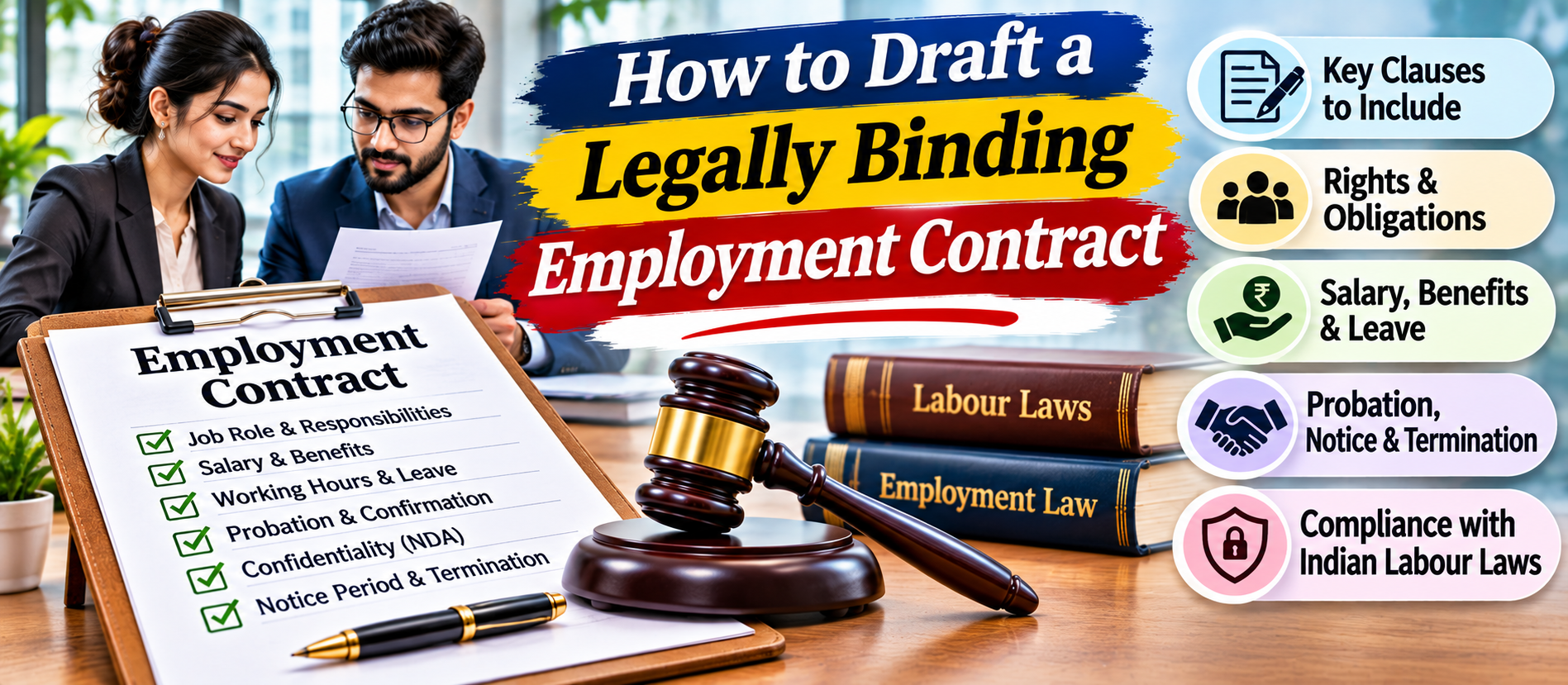
An employment contract is one of the most important documents in a professional relationship. It explains what an employee is expected to do and what the employer must provide in return. It can cover the job role, salary, working hours, leave, benefits, confidentiality, intellectual property, notice period and termination.
A clear contract protects both sides. It reduces confusion about expectations. It also creates a written record that can help resolve disagreements. However, simply signing a document does not make every clause valid. The terms must comply with Indian law. They must also be clear, lawful and accepted by both parties.
India's labor law framework has changed significantly. The four Labor Codes—the Code on Wages, 2019; Industrial Relations Code, 2020; Code on Social Security, 2020; and Occupational Safety, Health and Working Conditions Code, 2020—were brought into effect from 21 November 2025, according to the Ministry of Labor and Employment. Central rules and State-level implementation details must also be checked for the relevant establishment. Official government announcement.
This article explains how to draft an employment contract in India in simple language. It covers the clauses that employers should consider, the rights employees should understand, common drafting mistakes and a practical review checklist. It is intended as a general guide. A contract should be adapted to the job, industry, location and applicable law.
1. What Is an Employment Contract?
An employment contract is an agreement between an employer and an employee. It records the terms on which the employee agrees to work and the employer agrees to provide wages and other agreed benefits. It may be called an employment agreement, service agreement, appointment letter or contract of employment.
The document may be a detailed agreement signed by both parties or an appointment letter that contains the essential terms and is accepted by the employee. In some cases, an appointment letter and a separate policy document work together. If several documents form part of the employment terms, identify them clearly and explain which document prevails if there is a conflict.
An employment contract is different from an independent contractor agreement. An employee generally works within the employer's organization and is subject to a degree of direction and control. A genuine independent contractor usually provides services on a separate commercial basis. The label used in a document is not decisive. The real working relationship, duties, control and applicable legal tests matter.
2. What Makes an Employment Contract Legally Binding in India?
The Indian Contract Act, 1872 provides the general foundation for contracts. Section 10 states that agreements become contracts when they are made with free consent by parties competent to contract, for lawful consideration and a lawful object, and are not expressly declared void. Sections 11 to 23 deal with matters such as competency, free consent and lawful consideration or object. Read the Indian Contract Act, 1872 on India Code.
For an employment contract to be legally effective, consider these basic requirements:
- Clear parties: The employer and employee must be correctly identified.
- Capacity: The parties must be legally competent to enter into the agreement.
- Free consent: Acceptance should not be caused by coercion, fraud, misrepresentation or undue influence.
- Lawful terms: The contract must not require an illegal act or remove statutory rights.
- Clear obligations: The duties, pay and key conditions should be certain enough to understand.
- Acceptance: Both parties should sign or otherwise clearly accept the final terms.
- Required formalities: Any applicable writing, stamp, record-keeping or other legal requirement should be followed.
A signature does not validate a clause that is prohibited by law. For example, a term that attempts to waive minimum wages or prevent an employee from approaching a lawful authority may be unenforceable. The agreement must be read with applicable labor legislation, rules, notifications, standing orders and State laws.
3. Check the Applicable Employment Laws First
Before drafting, identify the type of establishment, employee category, work location and industry. Different laws and rules may apply to a factory, shop, office, mine, construction site, IT business, educational institution or other workplace.
The Four Labor Codes
- Code on Wages, 2019: Covers wage-related matters such as minimum wages, payment of wages, deductions, bonus and equal remuneration principles.
- Industrial Relations Code, 2020: Covers trade unions, industrial disputes, standing orders and specified aspects of employment relations.
- Code on Social Security, 2020: Consolidates social security provisions relating to areas such as provident fund, employee state insurance, gratuity, maternity benefits and other schemes.
- Occupational Safety, Health and Working Conditions Code, 2020: Covers workplace safety, health, working conditions and appointment-letter obligations, among other matters.
The Ministry of Labor and Employment states that the four Codes took effect on 21 November 2025. The Ministry's website also publishes Central Rules and implementation material. Employers must check the appropriate Central or State rules, notifications and transitional directions that apply to their establishment. Do not copy an old template that refers only to repealed or superseded legislation without checking the current legal position. Ministry of Labor and Employment – Labor Codes and Rules.
Appointment Letter Requirement
Section 6(f) of the Occupational Safety, Health and Working Conditions Code, 2020 requires an employer to issue an appointment letter to every employee on appointment, in the form and with the information prescribed by the appropriate Government. The Central Rules, 2026 include a prescribed appointment-letter format. The precise applicable rules and any State-specific requirements should be checked before issuing the document. See Section 6.
An appointment letter may be shorter than a full employment agreement, but it should not omit essential terms. Employers can use a detailed agreement together with the prescribed appointment-letter format where required. Ensure that the documents are consistent.
State-Specific Laws
State Shops and Establishments legislation, rules on working hours, weekly holidays, leave, registers, professional tax, local minimum wage notifications and other State requirements may apply. Some industries also have special laws or regulatory conditions. Check the law for the State where the employee actually works, including remote or multi-location arrangements where relevant.
4. Important Clauses to Include in an Employment Contract
Clause 1: Names and Legal Details of the Parties
Write the full legal name of the employer and employee. For a company, include its registered name, registered office address and, where useful, corporate identification details. State the name and designation of the person authorized to sign for the employer.
For the employee, include the full name and contact address. Collect identity information only to the extent required for lawful employment administration. Avoid placing unnecessary sensitive personal details in a contract that may be circulated widely.
Clause 2: Job Title, Department and Reporting Manager
State the employee's designation, department, reporting manager and broad role. A title alone may not explain the work. Add a short description of the main duties, responsibilities and expected outcomes.
If the employer may reasonably change the employee's reporting line or assign related duties, say so in clear terms. Avoid an unlimited clause that allows a major change in role, location or employment status without considering the contract and applicable law.
Clause 3: Date of Joining and Place of Work
Record the date on which employment begins. State the normal place of work, such as the office address, factory, branch or remote-work arrangement. If the role involves travel, client sites or transfers, explain the expected arrangements and the process for communicating a change.
For hybrid or remote work, state the approved work location, attendance expectations, working hours, equipment arrangements, information security rules and any requirement to attend the office. Do not assume that a general transfer clause automatically resolves every issue relating to relocation or expense reimbursement.
Clause 4: Type and Duration of Employment
Clearly identify whether the role is regular, fixed-term, probationary, part-time or another lawful category. If it is fixed-term, state the start date, end date and whether renewal may be considered. Do not imply a guaranteed renewal unless the employer intends to provide one.
Fixed-term employment should not be used as a label to avoid statutory obligations. The employee's rights and benefits must be assessed under the applicable law and the actual arrangement.
Clause 5: Probation and Confirmation
If the employee is on probation, state its duration and the process for review or confirmation. Explain whether the employer may extend probation, how the employee will be informed and what happens if no confirmation letter is issued.
Set reasonable performance expectations. Avoid wording that gives the employer unlimited discretion to extend probation indefinitely. Probation does not remove statutory protections or the need to follow lawful termination procedures.
Clause 6: Salary and Wage Structure
State the employee's gross annual or monthly compensation and provide a clear breakdown. Identify basic pay, dearness allowance where applicable, house rent allowance, special allowance, variable pay and other components. Explain which amounts are fixed and which depend on performance or eligibility.
Distinguish gross salary from take-home pay. Statutory deductions, tax withholding and employee contributions may affect the amount received. The contract should not promise a net amount unless the employer intends to bear the difference and has calculated the arrangement correctly.
Ensure that wages meet the applicable minimum wage and other statutory requirements. The Code on Wages regulates authorized deductions and wage-payment obligations. Section 18 restricts deductions to those permitted by the Code. An employer should not insert a general right to deduct any amount for any reason. Code on Wages, 2019.
Clause 7: Salary Payment Date and Method
Specify the wage period, normal payment date and payment method. State whether salary will be paid by bank transfer and how the employee should report an incorrect payment. Explain how payroll deductions and reimbursements will be shown.
The Code on Wages sets time limits for payment according to the wage period and contains rules for payment when employment ends. The contract should reflect the current statutory requirements rather than create a later payment date. Employers should also provide wage slips where required.
Clause 8: Incentives, Bonus and Variable Compensation
Describe the incentive plan, sales commission, performance bonus or other variable compensation. State the measurement period, eligibility conditions, calculation method, approval process and payment date. If a payment is discretionary, explain what that means and avoid presenting it as guaranteed salary.
Do not use an incentive clause to avoid a statutory bonus or other mandatory payment. Statutory eligibility and calculation rules apply independently of a private bonus plan.
Clause 9: Working Hours, Weekly Rest and Overtime
State the normal working days, daily hours, break periods and weekly rest day. Explain attendance, shift arrangements and the process for changing a shift. If the employee may work beyond normal hours, describe how overtime is authorized and compensated.
Working hours, overtime, rest intervals and leave are governed by the applicable Labor Code and rules, as well as any relevant State requirements. Do not assume that a salaried employee is automatically excluded from every working-time protection. Coverage depends on the employee's legal category and the applicable provision.
Clause 10: Leave and Holidays
Explain the leave categories available, such as annual or earned leave, casual leave, sick leave, public holidays and other statutory leave. State the process for applying, approval requirements, carry-forward rules and treatment of unused leave at separation, subject to applicable law.
Do not set leave below the statutory minimum. If the organization provides benefits above the legal minimum, state the additional entitlement clearly. Include a reference to the current employee handbook or leave policy and provide access to it.
Clause 11: Social Security and Statutory Benefits
Explain the statutory benefits that may apply, including provident fund, employee state insurance, gratuity, maternity benefits, employee compensation and other benefits under the Code on Social Security and applicable schemes. Eligibility may depend on the establishment, employee category, wage level, service period and statutory thresholds.
Do not promise that a benefit applies to every employee if the law makes it conditional. Equally, do not exclude an employee from a benefit merely by inserting a contrary sentence in the contract. State that statutory benefits will be provided in accordance with applicable law and identify the schemes that apply to the employee.
Clause 12: Reimbursements and Business Expenses
State which business expenses may be reimbursed, such as travel, accommodation, meals, communication or approved equipment. Explain the approval process, documentation, submission deadline and payment cycle. Clarify whether a company card or advance will be provided.
Separate genuine expense reimbursements from salary and allowances. Employees should not be required to pay ordinary business costs personally without a clear policy and lawful arrangement.
Clause 13: Confidentiality and Protection of Business Information
A confidentiality clause protects information that is not generally available to the public and that the employer has a legitimate reason to protect. Examples may include customer lists, pricing, business plans, source code, product designs, internal financial information, trade secrets and security credentials.
Define confidential information in a practical way. Explain how the employee may use it, who may receive it and what security steps are required. Include exceptions for information that is public through no fault of the employee, already lawfully known, independently developed or required to be disclosed by law.
Allow lawful reporting to regulators, courts or other competent authorities. A confidentiality clause should not prevent an employee from exercising statutory rights, reporting unlawful conduct or making disclosures protected by law.
Clause 14: Intellectual Property Ownership
Employees may create software, written content, designs, inventions, photographs, research, databases or other work during employment. The contract should explain how intellectual property created in the course of employment will be treated.
Identify the types of work covered and the connection required with the employee's duties, company resources or business. Explain the employee's obligation to disclose relevant inventions or work products and to sign reasonable documents needed to record or protect the employer's rights.
Do not assume that every idea an employee creates in personal time automatically belongs to the employer. The Copyright Act, 1957 contains rules about first ownership of copyright, including a provision concerning work made in the course of employment under a contract of service, subject to the Act and any agreement to the contrary. Patent ownership and assignment have their own statutory requirements. Use a carefully drafted clause that respects pre-existing work, personal projects and third-party rights.
Clause 15: Non-Disclosure, Data Security and Personal Information
Explain how the employee must handle personal data, customer records, employee information and company systems. Include requirements for passwords, access controls, secure devices, approved software, data transfer, reporting a security incident and returning company information.
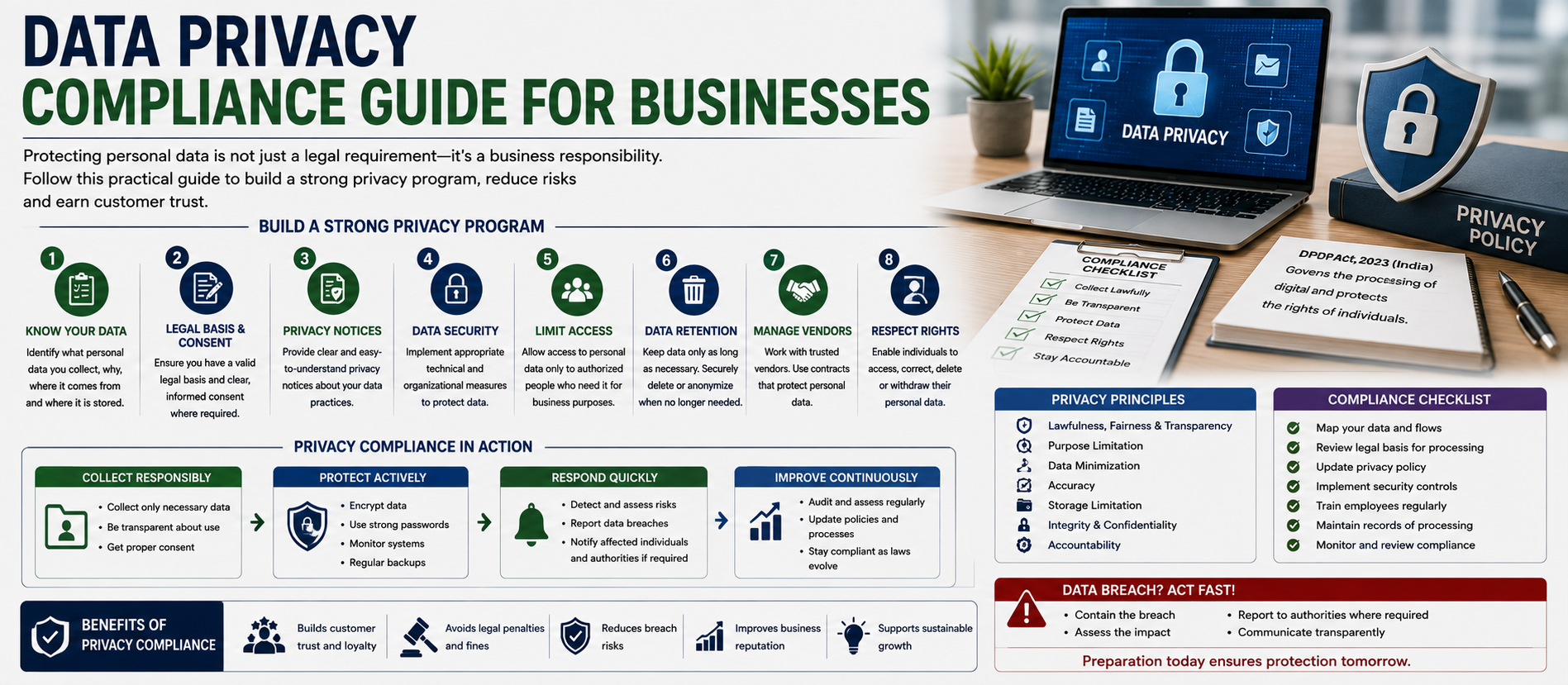
Where the organization handles personal data, its processes must comply with applicable data protection law and rules. A contract should not claim that an employee's signature alone makes every data-processing activity lawful. The employer must identify its own legal duties and provide suitable policies, training and safeguards.
Clause 16: Conflict of Interest and Outside Work
Ask employees to disclose material conflicts of interest. Examples may include a financial interest in a supplier, a close relationship affecting procurement decisions or outside work that competes with the employer or interferes with job duties.
If outside employment or consulting requires approval, explain the reason and approval process. Keep restrictions proportionate. A broad clause that attempts to control every lawful activity outside working hours may be unreasonable or legally questionable.
Clause 17: Non-Compete and Non-Solicitation
Employers sometimes include clauses that restrict employees from joining competitors or approaching customers after leaving. These clauses need careful legal review in India.
Section 27 of the Indian Contract Act, 1872 generally makes an agreement restraining a person from exercising a lawful profession, trade or business void to that extent, subject to the statutory exception relating to sale of goodwill. The Supreme Court in Percept D'Mark (India) Pvt. Ltd. v. Zaheer Khan (2006) held that a restrictive covenant extending beyond the term of the contract was void as a restraint of trade. The case also recognizes the distinction between restrictions during the contract and restrictions after it ends. Read the judgment.
A reasonable exclusivity or conflict restriction during employment may be treated differently from a post-employment ban. Do not assume that a post-termination non-compete clause is enforceable because the employee signed it. Confidentiality, protection of trade secrets and carefully framed non-solicitation provisions raise separate questions and should be drafted narrowly with legal advice.
Clause 18: Company Property and Equipment
List the equipment and property provided to the employee, such as a laptop, phone, access card, tools, documents, vehicle or security token. Explain permitted use, care, loss reporting and return procedures.
At separation, require the employee to return company property and transfer work-related files through approved systems. Any deduction for loss or damage must comply with wage laws and other applicable requirements. Avoid an automatic deduction of an arbitrary replacement amount.
Clause 19: Workplace Conduct, Discipline and Policies
Refer to applicable policies on conduct, attendance, safety, anti-harassment, equal opportunity, information security and use of company resources. Give the employee access to the policies and explain how updates will be communicated.
Disciplinary action should follow applicable law, standing orders where relevant, natural justice requirements and the organization's valid procedure. The contract should not give an unrestricted power to impose penalties without process.
Clause 20: Prevention of Sexual Harassment
Employers must comply with the Sexual Harassment of Women at Workplace (Prevention, Prohibition and Redressal) Act, 2013, commonly called the POSH Act, and applicable rules. The law requires covered employers to take preventive steps and provide a complaint mechanism. An Internal Committee is required at workplaces with ten or more employees, subject to the statutory framework. Complaints and proceedings must be handled in accordance with the law.
Include a clear reference to the organization's anti-harassment policy and complaint channels. Do not use an employment contract to replace the statutory committee or process. The employee should know where to report a concern and how confidentiality is protected.
Clause 21: Training, Qualifications and Professional Conduct
State whether the role requires specific qualifications, licences, certifications or professional registrations. Ask the employee to disclose any material restriction that prevents lawful performance of the role. If the employer provides paid training, describe the training arrangement and any lawful repayment obligation separately.
A training-cost recovery clause should be based on actual, reasonable and properly documented costs. It should not operate as a disguised penalty or an unreasonable restriction on the employee's right to resign.
Clause 22: Transfer, Travel and Relocation
If the role requires travel or transfer, state the possible locations, business reasons and process for issuing a transfer instruction. Explain reimbursement, relocation support and the expected notice. Consider whether a significant change in location or duties requires consultation or a written variation.
Clause 23: Notice Period and Resignation
State the notice period for the employee and employer, subject to statutory protections and applicable rules. Explain how notice must be given, whether garden leave may be used where lawful, how handover will work and whether the parties may agree to waive or shorten notice.
If payment in lieu of notice is permitted, explain the calculation method. Do not allow deductions that breach wage laws. The clause should not suggest that an employee can never resign or that the employer can retain earned wages as a punishment.
Clause 24: Termination of Employment
List the circumstances in which employment may end, such as resignation, expiry of a fixed term, mutual agreement, retirement, redundancy or termination for a lawful reason. Explain any applicable process, notice, hearing, inquiry or payment obligations.
Termination rules differ according to the employee's status, establishment, length of service and applicable law. The Industrial Relations Code and other laws may provide protections and procedures for specified workers and establishments. Contract wording cannot remove mandatory legal safeguards.
Clause 25: Final Settlement and Exit Formalities
Explain how final wages, approved reimbursements, leave encashment, gratuity or other applicable dues will be calculated and paid. Set out the return of company property, handover of records and cancellation of access. Provide an itemized statement of final payments and deductions.
Do not use a full-and-final settlement form to pressure an employee into surrendering statutory claims that cannot lawfully be waived. If a genuine dispute exists, obtain legal advice before drafting a settlement or release.
Clause 26: Grievance and Dispute Resolution
Identify the internal person or department to whom the employee may raise a concern. Explain the steps for review and escalation. A grievance procedure can help resolve misunderstandings early, but it should not prevent an employee from using statutory complaint mechanisms or approaching a competent authority.
If the contract contains an arbitration clause, have it reviewed under the Arbitration and Conciliation Act, 1996 and relevant employment law. Not every employment dispute can necessarily be diverted from statutory forums through a private arbitration clause. State the seat, procedure and scope only after legal review.
Clause 27: Governing Law, Notices and Entire Agreement
State that the contract is governed by the laws of India and identify the appropriate jurisdiction only where legally valid. A jurisdiction clause cannot create jurisdiction in a court that otherwise has none. Specify how formal notices may be delivered and how a party can update contact details.
An entire-agreement clause can identify the documents that form the employment terms. Add a variation clause stating that changes must be recorded in writing and accepted by authorized persons. Preserve mandatory rights that apply by law, even if they are not repeated in the contract.
5. How to Draft the Contract Step by Step
- Identify the employment category: Confirm whether the person is an employee, fixed-term employee, apprentice, consultant or independent contractor. Do not choose a label only to reduce compliance costs.
- Check the applicable law: Identify the relevant Labor Codes, rules, State Shops and Establishments law, minimum wage notification, standing orders and sector-specific requirements.
- Prepare the job description: Write the designation, reporting line, duties, work location and performance expectations.
- Calculate compensation: Confirm minimum wage compliance, salary components, statutory contributions, benefits and payroll deductions.
- Draft each clause in plain language: Use short sentences. Define important terms. Avoid conflicting provisions and unexplained abbreviations.
- Attach relevant policies: Identify the handbook, leave policy, POSH policy, IT policy and incentive plan that apply. Give the employee access to them.
- Review restrictive clauses: Obtain legal advice on confidentiality, intellectual property, non-solicitation, training costs and post-employment restrictions.
- Check the appointment-letter format: Follow the applicable OSHWC Code rules and any State-specific prescribed form.
- Allow time for review: Give the employee a reasonable opportunity to read the document and ask questions before signing.
- Sign and store the final version: Ensure both parties receive the same signed copy. Store it securely with the relevant employment records.
6. Should an Employment Contract Be on Stamp Paper or Notarized?
There is no single rule that every employment contract in India must be printed on a particular value of stamp paper or notarized. Stamp duty and documentation requirements can depend on the State, the nature of the instrument and applicable stamp legislation. A contract may be valid under general contract principles without notarization, but that does not remove any separate statutory or evidentiary requirement.
Check the current State stamp law and the relevant registration or documentation rules before execution. If stamp duty is payable, use the permitted stamp paper, e-stamp or other authorized method. Notarization should not be treated as a substitute for correct drafting, lawful terms or required statutory compliance.
7. Can an Employment Contract Be Signed Electronically?
Electronic records and electronic signatures are recognized under the Information Technology Act, 2000, subject to the Act's conditions and exclusions. Many employers use digital signing platforms to issue appointment letters and employment agreements. The employer should use a reliable process that can show the final document, identity or authentication method, date and evidence of acceptance.
Some documents or transactions may be subject to specific legal formalities. Confirm whether the chosen electronic signature method is appropriate for the document and jurisdiction. Keep a copy that can be retrieved and verified later.
8. Common Employment Contract Drafting Mistakes
- Copying an old template: Labor law has changed. Review current Central and State rules before using a previous format.
- Using vague job duties: Unclear responsibilities create disputes about performance and role changes.
- Showing only CTC: Explain salary components, deductions and statutory contributions.
- Ignoring minimum wages: A private agreement cannot lawfully set wages below the applicable minimum.
- Making every deduction automatic: Deductions must be permitted by law and properly supported.
- Using an overbroad non-compete: Post-employment restraints may be void under Section 27 of the Contract Act.
- Ignoring intellectual property: State clearly how work created during employment is treated.
- Leaving policies unidentified: Name the policies that form part of the employment framework and provide access to them.
- Ignoring State requirements: Local working-hour, leave and establishment rules may apply.
- Failing to give a signed copy: Both parties should keep the same final document.
- Confusing an employee with a contractor: The real working relationship matters more than the heading of the contract.
9. Employment Contract Review Checklist
- Are the employer and employee correctly identified?
- Is the employment category clear?
- Are the job title, duties, reporting line and work location stated?
- Are the joining date, probation and fixed-term dates accurate?
- Is the salary structure clear and compliant with minimum wage requirements?
- Are payment dates, wage slips and lawful deductions addressed?
- Are working hours, weekly rest, overtime and leave compliant?
- Are statutory social security benefits correctly described?
- Are confidentiality, data security and intellectual property clauses proportionate?
- Have non-compete and non-solicitation clauses been legally reviewed?
- Are notice, termination and final settlement terms clear?
- Are POSH and grievance procedures explained?
- Have State-specific laws and rules been checked?
- Has the prescribed appointment letter been issued where required?
- Have both parties signed the final version and received a copy?
10. Frequently Asked Questions (FAQs)
Q1. Is an employment contract mandatory in India?
The legal requirement depends on the applicable law and employment category. Section 6(f) of the Occupational Safety, Health and Working Conditions Code, 2020 requires an appointment letter for every employee covered by that provision, in the prescribed form. A detailed contract is also strongly recommended because it records the terms of employment.
Q2. What makes an employment contract legally binding?
It must satisfy the requirements of contract law, including competent parties, free consent, lawful consideration and lawful object. Its terms must also comply with applicable labor laws. A signature cannot make an illegal or prohibited clause enforceable.
Q3. Can an employer change the terms of an employment contract?
A material change should be made through a lawful process and, where required, with the employee's agreement. The employer should check the contract, applicable standing orders, Labor Codes and State law before changing salary, location, duties or other important terms.
Q4. Can an employer stop an employee from joining a competitor after resignation?
A post-employment non-compete restriction is generally difficult to enforce in India because Section 27 of the Indian Contract Act restricts agreements in restraint of trade. The Supreme Court's decision in Percept D'Mark v. Zaheer Khan explains that a restraint extending beyond the contract term is generally void. Confidentiality and protection of genuine trade secrets are separate issues.
Q5. Is a non-disclosure agreement valid for employees?
A carefully drafted confidentiality clause or NDA may protect legitimate confidential information and trade secrets. It should define protected information, include reasonable exceptions and not prevent lawful reporting or exercise of statutory rights.
Q6. Can an employer deduct salary for notice period or damaged equipment?
Any deduction must comply with the Code on Wages and other applicable law. The employer should identify the legal basis, follow the required process and calculate the amount correctly. A general contractual clause does not authorize every possible deduction.
Q7. Does an employment contract need to be notarized?
Not every employment contract requires notarization. However, State stamp duty and other formalities may apply. Check the applicable law and the nature of the document before signing.
Q8. Can an employment agreement be signed online?
Electronic records and signatures may be valid under the Information Technology Act, 2000, subject to legal conditions and exclusions. Use a reliable signing process and retain evidence of the final document and acceptance.
Q9. What is the difference between an appointment letter and an employment contract?
An appointment letter confirms the appointment and key terms. An employment contract may provide more detailed provisions on duties, compensation, confidentiality, intellectual property, leave, termination and dispute resolution. One document may serve both purposes if it meets applicable legal requirements.
Q10. Can an employee be asked to sign a contract after joining?
An employer may need to issue or update employment documentation, but it should not use the process to impose unlawful or unfair retrospective terms. The employee should be given the document to review, and any changes should be handled lawfully.
Q11. Does a fixed-term employee have statutory benefits?
Fixed-term status does not automatically remove statutory protections. Benefits and entitlements depend on the applicable Labor Codes, rules, eligibility conditions and the actual employment arrangement. Employers should not assume that a fixed-term label excludes all benefits.
Q12. Should a small business or startup use an employment contract?
Yes. A small business should document the role, salary, working hours, leave, confidentiality, equipment, notice and statutory benefits. The format can be concise, but it must still comply with applicable law and the prescribed appointment-letter requirements.
11. Conclusion
A legally sound employment contract should be clear, fair and compliant with Indian law. It should explain the role, salary, working hours, leave, benefits, confidentiality, intellectual property, notice and termination. It should also reflect the current Labor Codes, applicable rules and State-specific employment requirements.
⚠ Watch Out
Employers should avoid copied clauses that are too broad or legally outdated. Employees should read the full document and ask questions about unclear terms before signing. Both sides should keep a signed copy and retain relevant policies and records.
The best employment contract is not the longest one. It is the one that accurately describes the working relationship, protects legitimate interests and respects statutory rights. For complex roles, senior employees, fixed-term arrangements, sensitive intellectual property or multi-State operations, seek advice from an employment lawyer before issuing the final document.
Legal Disclaimer
This article is for general educational and informational purposes only. It is not legal advice and does not create a lawyer-client relationship. Indian labor laws, rules, notifications and State requirements may change. The four Labour Codes came into effect on 21 November 2025, and employers should verify the current Central and State rules, notifications, transitional provisions and applicable coverage before relying on this guide. The validity of any clause depends on its wording, facts and applicable law. Consult a qualified employment lawyer or labor-law professional before drafting, signing, varying or enforcing an employment contract.
Published by Digiifrog | www.digiifrog.com
For website development, digital solutions and online growth services, visit Digiifrog.
Ready to Grow?
Talk to us about a strategy tailored to your brand — we will help you stand out in search, AI discovery and social.

Comments (0)
Log in to leave a comment.