📋 Quick Summary
In this article:
What Is Hybrid Cloud Software?
Why Hybrid Cloud Is Becoming Important
Top Hybrid Cloud Software Trends in 2026
1. AI-Powered Hybrid Cloud Management
2. Hybrid Cloud and Kubernetes
3. Cloud-Native Applications Across Hybrid Environments
4. Hybrid Cloud for Artificial Intelligence Workloads
5. Edge Computing and Hybrid Cloud
6. Hybrid Cloud Security
7. Multi-Cloud and Hybrid Cloud Convergence
8. Infrastructure as Code
9. Hybrid Cloud Observability
💡 Key Insight
Hybrid cloud software has become an important part of modern digital infrastructure as businesses look for greater flexibility, stronger security, better scalability, and more control over where applications and data are processed. Instead of choosing between a completely public cloud environment and a fully private infrastructure, organizations can combine different environments according to their business requirements.
The latest hybrid cloud software trends are moving beyond simple infrastructure connectivity. Businesses are increasingly adopting AI-powered cloud management, cloud-native applications, containerization, Kubernetes, automated security, edge computing, unified observability, data mobility, and intelligent workload orchestration. These technologies are helping organizations build flexible digital environments that can support both traditional applications and emerging AI workloads.
This WordPress-ready HTML article is prepared for Digiifrog (www.digiifrog.com) with a strong focus on SEO, AEO, GEO, and AI Search optimization.
What Is Hybrid Cloud Software?
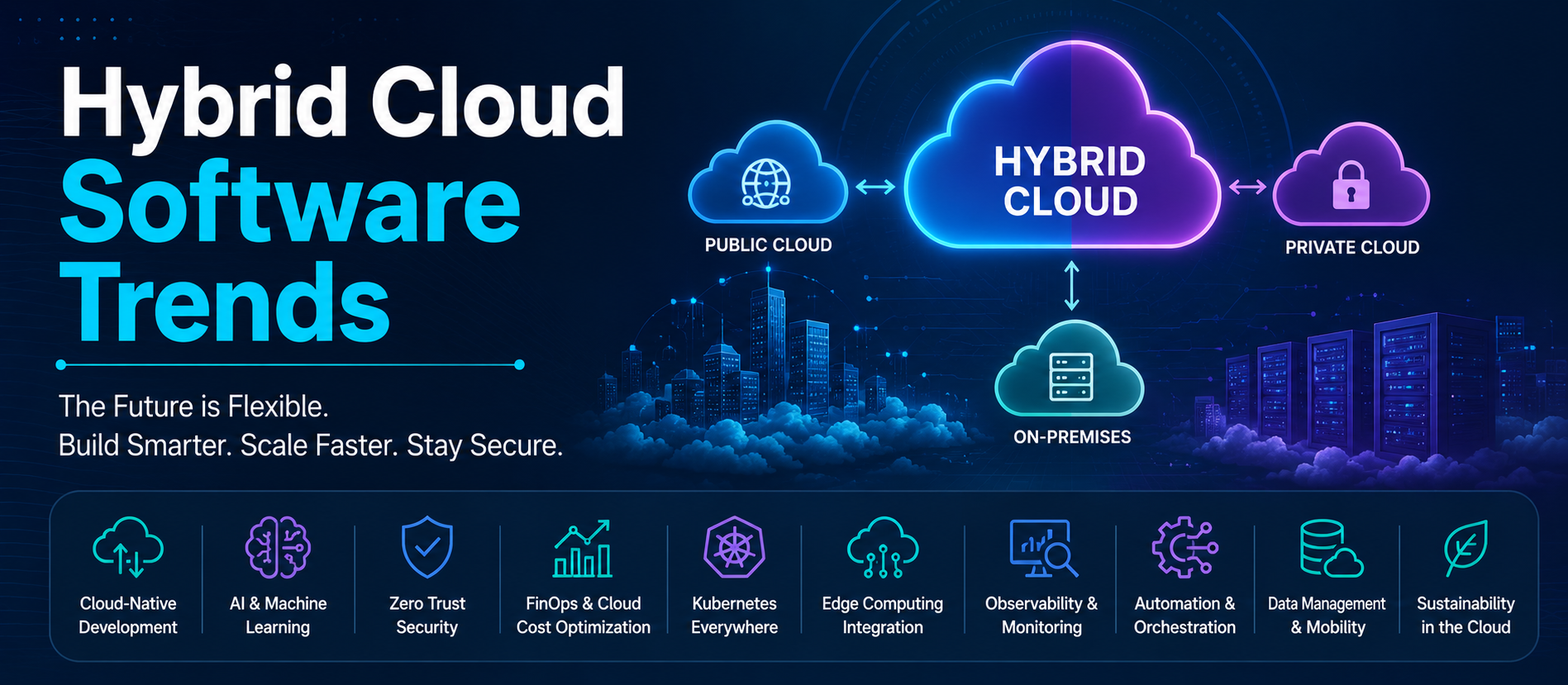
Hybrid cloud software refers to technologies and platforms that help organizations operate workloads, applications, data, and services across a combination of private infrastructure and public or hosted cloud environments.
A hybrid cloud architecture can connect on-premises servers with public cloud resources, private clouds, colocation facilities, edge locations, and specialized infrastructure. The objective is to create an environment where workloads can be placed in the location that best matches their security, performance, compliance, cost, and operational requirements.
- Private cloud integration
- Public cloud connectivity
- On-premises infrastructure management
- Container orchestration
- Workload migration
- Data synchronization
- Cloud security
- Infrastructure automation
- Monitoring and observability
- AI-powered cloud management
Why Hybrid Cloud Is Becoming Important
Businesses operate under different technical and regulatory requirements. Some workloads benefit from the scalability of public cloud infrastructure, while other applications may need greater control over data, specialized hardware, low-latency processing, or existing investments in on-premises systems.
Hybrid cloud provides an alternative to a one-size-fits-all infrastructure strategy. Organizations can select the environment that best matches each workload instead of forcing every application into the same architecture.
- Flexible workload placement
- Better infrastructure scalability
- Support for legacy systems
- Greater control over sensitive data
- Improved disaster recovery options
- Support for distributed operations
- Cloud migration flexibility
- Potential cost optimization
Top Hybrid Cloud Software Trends in 2026
The hybrid cloud market is evolving rapidly. The following trends are particularly important for organizations planning or modernizing hybrid infrastructure.
1. AI-Powered Hybrid Cloud Management
Artificial intelligence is becoming increasingly important in cloud infrastructure management. AI can analyze large volumes of operational information, identify unusual behavior, summarize infrastructure events, recommend optimization opportunities, and help administrators investigate problems.
AI-assisted cloud operations can reduce the amount of manual analysis required from infrastructure teams. Instead of reviewing hundreds of metrics independently, administrators can receive summarized information about performance changes, resource utilization, potential failures, and security events.
AI can also support workload optimization by identifying underused resources or patterns that indicate capacity requirements. Human approval remains important for high-impact infrastructure changes.
2. Hybrid Cloud and Kubernetes
Kubernetes has become an important technology for organizations running containerized applications across multiple environments. Containers can help standardize application deployment and make workloads more portable between infrastructure environments.
Hybrid cloud Kubernetes strategies can allow organizations to operate applications across on-premises infrastructure and public cloud environments while maintaining a common orchestration model.
This can be especially valuable for businesses that need consistent application deployment across different locations.
- Container orchestration
- Application portability
- Automated scaling
- Multi-environment deployment
- Infrastructure consistency
3. Cloud-Native Applications Across Hybrid Environments
Organizations are increasingly designing applications using cloud-native principles even when some components run outside public cloud infrastructure. Microservices, containers, APIs, automated deployment, and infrastructure as code can support flexible application architectures.
A cloud-native application does not necessarily mean that every component must run in a public cloud. Businesses can use cloud-native development practices across hybrid infrastructure when operational requirements justify it.
4. Hybrid Cloud for Artificial Intelligence Workloads
AI workloads are creating new infrastructure requirements. Training and inference can require significant computing resources, specialized accelerators, large datasets, and efficient data pipelines.
Some organizations may use public cloud resources for scalable AI experimentation while keeping sensitive datasets or certain production workloads within controlled environments. Hybrid architectures can provide flexibility when AI workloads have different security, performance, or cost requirements.
AI infrastructure planning may involve GPUs, specialized accelerators, high-performance storage, data pipelines, model-serving systems, and workload orchestration.
5. Edge Computing and Hybrid Cloud
Edge computing extends processing closer to where data is generated. This can be important for manufacturing, retail, logistics, healthcare, telecommunications, smart buildings, and other environments where low latency or local processing is important.
Hybrid cloud architectures can connect edge locations with centralized cloud and private infrastructure. Data can be processed locally when immediate decisions are required while selected information can be transferred to centralized systems for analytics, reporting, and long-term storage.
6. Hybrid Cloud Security
Security is one of the most important considerations in hybrid cloud adoption. When workloads operate across multiple environments, organizations need consistent identity, access, monitoring, configuration, and data protection policies.
Hybrid cloud security strategies increasingly include zero-trust principles, identity-based access, encryption, centralized logging, cloud security posture management, vulnerability management, and automated policy enforcement.
- Identity and access management
- Multi-factor authentication
- Encryption
- Cloud security posture management
- Network segmentation
- Centralized security monitoring
- Vulnerability management
- Zero Trust controls
7. Multi-Cloud and Hybrid Cloud Convergence
Many organizations use more than one cloud provider because different platforms offer different services, geographic coverage, pricing structures, or technical capabilities. As a result, hybrid cloud and multi-cloud strategies are increasingly connected.
Managing multiple environments can create complexity. Organizations need consistent policies, visibility, identity management, cost controls, and workload governance across different platforms.
Hybrid cloud management platforms can help create a more unified operational model across these environments.
8. Infrastructure as Code
Infrastructure as Code, commonly known as IaC, allows infrastructure configurations to be defined and managed through code and automation rather than relying entirely on manual configuration.
IaC can improve consistency across hybrid environments. Teams can create repeatable infrastructure configurations, track changes, review deployments, and automate provisioning.
This approach can reduce configuration drift and make infrastructure changes easier to reproduce.
9. Hybrid Cloud Observability
Observability is becoming essential as applications become distributed across multiple environments. IT teams need visibility into infrastructure, applications, networks, containers, databases, APIs, and user experiences.
Modern observability platforms can combine logs, metrics, traces, events, and other telemetry into a centralized view. AI-assisted observability can help identify patterns and reduce alert overload.
For hybrid cloud environments, observability is especially important because an application problem may originate from a cloud service, on-premises system, network connection, container, database, or external dependency.
10. Hybrid Cloud Automation
Automation is a central component of successful hybrid cloud operations. Manual infrastructure management becomes increasingly difficult as the number of environments, applications, and workloads grows.
Automation can support provisioning, configuration management, application deployment, scaling, backup, monitoring, security responses, and resource optimization.
- Automated provisioning
- Application deployment
- Configuration management
- Resource scaling
- Backup automation
- Security workflows
- Incident response
- Cost optimization
11. Data Mobility Across Hybrid Environments
Data mobility is becoming more important as businesses distribute workloads across private infrastructure, cloud platforms, and edge locations.
Organizations need reliable methods for moving, synchronizing, replicating, protecting, and governing data across environments. Data movement should also consider latency, bandwidth, security, compliance, and cost.
Modern hybrid data strategies increasingly focus on keeping data available where applications need it while maintaining appropriate governance and protection.
12. Hybrid Cloud Disaster Recovery
Hybrid cloud can provide organizations with additional options for business continuity and disaster recovery. Critical systems can use cloud resources as a recovery environment, while backup data can be maintained across geographically separated locations.
However, a disaster recovery plan should not depend solely on having cloud infrastructure available. Businesses should define recovery objectives, test restoration procedures, document responsibilities, and regularly validate that systems can actually be recovered.
13. Serverless and Hybrid Architectures
Serverless computing allows developers to run application functions without directly managing the underlying servers. Although serverless is strongly associated with public cloud platforms, some organizations may combine serverless-style architectures with other infrastructure components.
Hybrid architectures can use managed cloud services for selected application components while retaining control over other workloads that have specialized infrastructure or compliance requirements.
14. Platform Engineering for Hybrid Cloud
Platform engineering is becoming increasingly relevant as organizations attempt to simplify cloud operations for developers. Internal platforms can provide standardized deployment workflows, approved infrastructure patterns, security controls, monitoring, and developer tools.
For hybrid cloud environments, platform engineering can create a consistent experience for deploying applications across different infrastructure locations.
The goal is to reduce infrastructure complexity for development teams without removing necessary governance.
15. FinOps and Hybrid Cloud Cost Optimization
Cloud flexibility can create cost-management challenges. Organizations may have resources distributed across multiple cloud providers, private infrastructure, and on-premises systems.
FinOps practices help businesses understand cloud spending, allocate costs, identify waste, optimize resource usage, and create financial accountability for technology consumption.
Hybrid cloud cost optimization may involve shutting down unused resources, rightsizing infrastructure, selecting appropriate workload locations, improving storage policies, and monitoring usage patterns.
16. Hybrid Cloud and Zero Trust Architecture
Traditional security models often relied heavily on network boundaries. Hybrid cloud environments make those boundaries more complex because users, applications, and data can exist across multiple locations.
Zero Trust strategies emphasize verifying identity and access rather than automatically trusting users or systems based on network location.
Hybrid cloud environments can benefit from least-privilege access, device verification, continuous monitoring, segmentation, and identity-aware policies.
17. Low-Code and No-Code Cloud Automation
Low-code and no-code technologies are making certain cloud automation tasks more accessible to business and operations teams. Users can create workflows, connect applications, automate notifications, and manage repetitive processes without writing every component from scratch.
When used with appropriate governance, these platforms can reduce the burden on IT departments and allow teams to automate routine business workflows faster.
18. Hybrid Cloud and Data Sovereignty
Data sovereignty and regulatory requirements can influence where organizations store and process information. Some businesses need to maintain certain categories of data within specific geographic or legal boundaries.
Hybrid architectures can provide greater flexibility by allowing organizations to keep sensitive workloads in controlled environments while using cloud resources for other applications.
Businesses should always evaluate applicable legal, contractual, regulatory, and industry requirements before selecting a data architecture.
19. AI-Driven Cloud Security and Threat Detection
As hybrid environments generate large amounts of security telemetry, AI can help security teams identify unusual behavior, prioritize alerts, correlate events, and accelerate investigations.
AI-driven security should complement rather than replace established security controls. Organizations still need strong identity management, secure configurations, vulnerability management, encryption, logging, backups, and incident-response procedures.
20. Unified Hybrid Cloud Management Platforms
As organizations operate increasingly complex infrastructure, there is growing demand for centralized management. Unified platforms can provide visibility into workloads, resources, applications, policies, security, and costs across multiple environments.
A centralized management approach can reduce operational fragmentation and help IT teams understand the broader state of the organization's technology environment.
Benefits of Hybrid Cloud Software
Hybrid cloud software can provide several strategic benefits when implemented correctly.
- Greater infrastructure flexibility
- Support for legacy and modern applications
- Improved workload portability
- Better control over sensitive information
- Scalable cloud capacity
- Support for distributed computing
- Improved disaster recovery options
- Potential cost optimization
- More flexible AI infrastructure
- Stronger operational automation
Challenges of Hybrid Cloud Adoption
Hybrid cloud is powerful, but it can also introduce complexity. Organizations must manage multiple infrastructure environments, security policies, networking models, monitoring systems, identity configurations, and operational processes.
Infrastructure Complexity
Managing different environments requires strong architecture and operational discipline.
Security Complexity
Security policies need to remain consistent across cloud, private infrastructure, and edge locations.
Data Synchronization
Data movement between environments can create technical, security, performance, and cost challenges.
Skills Requirements
Hybrid cloud teams may need expertise in cloud platforms, networking, containers, automation, security, databases, observability, and infrastructure management.
Cost Management
Without effective monitoring and governance, cloud consumption can grow unexpectedly.
How to Choose Hybrid Cloud Software
Businesses should begin with their workload and business requirements rather than selecting technology first.
Assess Your Current Infrastructure
Document servers, applications, databases, cloud services, network connections, data stores, and critical dependencies.
Classify Workloads
Determine which workloads require low latency, high scalability, specialized hardware, strong data controls, or compatibility with legacy systems.
Define Security Requirements
Establish authentication, access, encryption, monitoring, segmentation, backup, and compliance requirements before designing the architecture.
Evaluate Integration
Hybrid cloud software should integrate with existing systems and automation tools. Poor integration can increase operational complexity.
Plan for Scalability
The architecture should support future applications, users, data volumes, AI workloads, and infrastructure requirements.
Hybrid Cloud for Small and Mid-Sized Businesses
Hybrid cloud is not limited to large enterprises. Small and mid-sized businesses can use hybrid strategies when they need to retain certain infrastructure while adopting cloud services.
For example, a growing business may keep a specialized application on existing infrastructure while using cloud services for collaboration, backup, analytics, customer applications, and scalable workloads.
⚠ Watch Out
The key is to avoid unnecessary complexity. A smaller organization should adopt hybrid cloud where it solves a real business requirement rather than using multiple environments simply because the technology is available.
Hybrid Cloud for AI and Digital Transformation
AI is becoming a major driver of infrastructure modernization. Businesses may need different environments for model development, data processing, inference, application hosting, and secure storage.
Hybrid infrastructure can help organizations select appropriate environments for different AI workloads. Sensitive information can remain under stronger organizational controls while scalable computing resources can be used where appropriate.
This creates opportunities for businesses to combine AI with automation, analytics, customer service, cybersecurity, document processing, and intelligent applications.
SEO, AEO, GEO and AI Search Optimization for Hybrid Cloud Content
Businesses publishing hybrid cloud content should optimize information for both traditional search engines and AI-powered discovery systems. SEO improves search visibility, AEO focuses on direct answers to questions, and GEO helps content provide useful context for generative search experiences.
AI Search optimization benefits from clearly structured information, descriptive headings, concise definitions, practical examples, comparisons, FAQs, and consistent terminology. Technical content should explain complex concepts in language that both technical and business audiences can understand.
Common Hybrid Cloud Mistakes
Moving Everything to the Cloud Without a Strategy
Cloud adoption should be based on workload requirements rather than a blanket migration approach.
Keeping Too Many Systems On-Premises Without Reviewing Their Value
Existing infrastructure should be evaluated based on business value, performance, security, cost, and lifecycle requirements.
Ignoring Networking
Hybrid environments depend on reliable connectivity. Network design, latency, bandwidth, redundancy, and security should be considered early.
Weak Identity Management
Users and applications may access resources across multiple environments. Centralized identity policies and least-privilege access are important.
Failing to Monitor Costs
Cloud and hybrid infrastructure should be measured continuously so unused resources and unexpected consumption can be addressed.
Not Testing Disaster Recovery
A recovery plan should be tested regularly rather than assumed to work.
How to Build a Hybrid Cloud Roadmap
A practical roadmap can be developed in several stages.
Stage 1: Discover
Inventory infrastructure, applications, data, users, dependencies, security controls, and current cloud services.
Stage 2: Classify
Classify workloads based on performance, security, compliance, latency, cost, scalability, and technical dependencies.
Stage 3: Design
Create the target architecture, including networking, identity, data movement, security, monitoring, automation, and disaster recovery.
Stage 4: Pilot
Move or modernize a limited number of workloads first. Measure performance, reliability, security, cost, and operational effort.
Stage 5: Automate
Use infrastructure as code, CI/CD, policy automation, monitoring, and workflow automation to reduce manual operations.
Stage 6: Optimize
Continuously review cost, security, application performance, resource usage, and business outcomes.
Future of Hybrid Cloud Software
The future of hybrid cloud will likely be defined by greater automation, AI-assisted operations, distributed computing, unified management, and workload portability.
Cloud environments are becoming less about a single destination and more about an interconnected operating model. Businesses will increasingly expect applications and data to operate across cloud, private, edge, and specialized infrastructure according to business requirements.
AI may also become a central control layer for cloud operations by helping teams understand infrastructure behavior, identify optimization opportunities, predict failures, and automate routine tasks.
Frequently Asked Questions About Hybrid Cloud Software
What is hybrid cloud software?
Hybrid cloud software helps organizations manage and connect workloads, applications, and data across private infrastructure and public or hosted cloud environments.
What are the main benefits of hybrid cloud?
The main benefits include flexibility, workload portability, scalability, support for legacy systems, greater control over sensitive workloads, disaster recovery options, and the ability to use different infrastructure environments for different requirements.
Is hybrid cloud suitable for small businesses?
Yes, when a small business has a clear reason to combine cloud and existing infrastructure. Small businesses should avoid unnecessary complexity and adopt hybrid architecture only when it provides practical business value.
How does AI affect hybrid cloud?
AI can improve hybrid cloud operations through intelligent monitoring, anomaly detection, optimization recommendations, workload analysis, security analytics, and automation.
What is Kubernetes in hybrid cloud?
Kubernetes is a container orchestration platform that can help organizations deploy and manage containerized applications across different infrastructure environments, including hybrid cloud environments.
Is hybrid cloud more secure than public cloud?
Not automatically. Security depends on architecture, configuration, identity controls, monitoring, patching, encryption, access management, and operational practices. Hybrid cloud can provide greater control for certain workloads, but it also introduces additional management complexity.
What is the difference between hybrid cloud and multi-cloud?
Hybrid cloud generally combines private infrastructure with public or hosted cloud resources. Multi-cloud refers to using multiple cloud providers. An organization can use both hybrid and multi-cloud strategies at the same time.
Conclusion
The latest hybrid cloud software trends show that cloud infrastructure is moving toward more connected, automated, intelligent, and distributed operating models. Businesses are combining private infrastructure, public cloud, edge computing, containers, AI platforms, and specialized services to create environments that match their operational requirements.
AI-powered cloud management, Kubernetes, cloud-native applications, edge computing, Zero Trust, observability, Infrastructure as Code, FinOps, data mobility, and unified management are becoming important components of modern hybrid cloud strategies.
However, successful hybrid cloud adoption requires more than technology. Organizations need clear workload classification, strong security, reliable networking, effective governance, cost management, automation, monitoring, and tested disaster recovery processes.
For businesses looking to explore AI-powered automation, cloud modernization, digital transformation, intelligent software, and modern technology strategies, Digiifrog can help develop practical approaches. Visit www.digiifrog.com to learn more.
Quick Answer: What Are the Biggest Hybrid Cloud Software Trends?
The biggest hybrid cloud software trends include AI-powered cloud management, Kubernetes and containers, cloud-native applications, hybrid AI infrastructure, edge computing, Zero Trust security, multi-cloud management, Infrastructure as Code, unified observability, cloud automation, data mobility, FinOps, platform engineering, and centralized hybrid cloud management. Businesses should adopt these technologies according to workload requirements, security needs, operational complexity, and measurable business value.
Ready to Grow?
Talk to us about a strategy tailored to your brand — we will help you stand out in search, AI discovery and social.

Comments (0)
Log in to leave a comment.