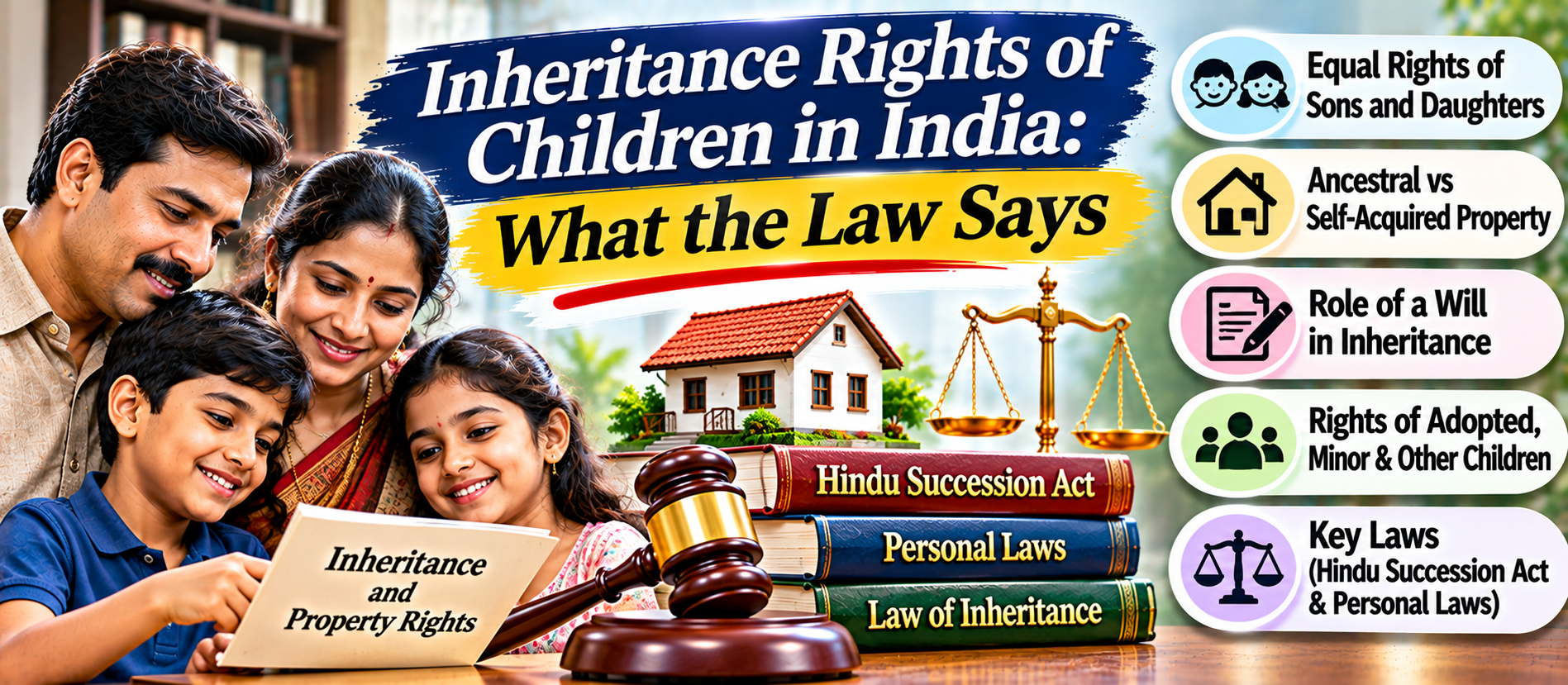
📋 Quick Summary
In this article:
1. Introduction
2. What Do Inheritance Rights Mean?
3. Which Succession Law Applies in India?
4. Inheritance Rights of Children under the Hindu Succession Act, 1956
4.1 Sons and daughters as Class I heirs
4.2 Equal coparcenary rights of daughters
4.3 Rights of children when a Hindu woman dies
5. Ancestral Property and Self-Acquired Property: What Is the Difference?
5.1 Ancestral or coparcenary property
5.2 Self-acquired or separate property
5.3 A simple illustration
Digiifrog | Legal Awareness — www.digiifrog.com
A clear guide to the property rights of sons, daughters, adopted children and other children under Indian succession laws.
Table of Contents
- Introduction
- What inheritance rights mean
- Which law applies?
- Rights under the Hindu Succession Act
- Ancestral and self-acquired property
- What happens when a parent makes a will?
- Rights of adopted children
- Children from void or voidable marriages
- Rights of minor children
- Christian, Muslim and other succession rules
- How a child can claim an inheritance
- Common disputes and mistakes
- Frequently asked questions
1. Introduction
Inheritance can become a difficult issue after the death of a parent. Disagreements may arise between sons and daughters, between children and a surviving spouse, or between members of a joint family. Questions also arise when a parent leaves a will, transfers property during life, or names someone else as a nominee.
Indian law recognizes the inheritance rights of children. However, there is no single rule that applies to every family and every asset. The result depends on the personal law governing the family, the type of property, whether the owner died with or without a valid will, and the facts of the case.
For example, Hindu daughters have the same coparcenary rights as sons in qualifying Mitakshara joint family property. A child may also inherit a parent's separate property under the applicable succession rules. But a child does not automatically own a share in every property held by a living parent.
This guide explains the main principles in simple language. It covers sons, daughters, adopted children, children from certain invalid marriages, ancestral property, self-acquired property, wills and the steps involved in claiming an inheritance.
Important: This article provides general legal information for India. It is not personal legal advice. Succession rules can differ by religion, community, state, asset type and family history. Consult an Indian succession lawyer before taking action.
2. What Do Inheritance Rights Mean?
Inheritance rights are legal rights to receive property, money or other assets after a person dies. The person who dies is often called the deceased or the owner. The people who receive the estate are called heirs or beneficiaries, depending on the legal context.
A child may receive property in two broad ways:
- Intestate succession: The parent dies without leaving a valid will for the property. The applicable succession law decides who inherits and in what shares.
- Testamentary succession: The parent leaves a valid will. The will generally decides who receives the property, subject to the law that applies and any limits on the owner's power to dispose of it.
Inheritance is different from maintenance. A child may have a right to maintenance while a parent is alive under the relevant law. That does not mean the child already owns a fixed share of all the parent's assets.
It is also important to distinguish ownership from possession. A child may have an ownership share even if another family member occupies the property. Equally, living in a family home does not by itself prove ownership.
3. Which Succession Law Applies in India?
India does not have one uniform succession law for all families. Different personal laws and statutory rules may apply. The legal position can also depend on whether the marriage was solemnized under a special law and on the type of asset involved.
- Hindus, Buddhists, Jains and Sikhs: The Hindu Succession Act, 1956 generally governs intestate succession, subject to its scope and exceptions. The Hindu Adoptions and Maintenance Act, 1956 is also relevant to adoption.
- Muslims: Muslim personal law generally governs inheritance, with rules that depend on the applicable school and the surviving heirs.
- Indian Christians and many other persons covered by the Act: The Indian Succession Act, 1925 contains rules for intestate succession. Its application has statutory exceptions.
- Parsis: The Indian Succession Act contains special provisions for Parsi intestate succession.
- Special Marriage Act cases: The effect of marrying under the Special Marriage Act must be checked carefully. The applicable succession provisions can depend on the parties' personal laws and the statutory conditions.
Do not assume that a rule applying to one religion automatically applies to another. Before calculating a child's share, identify the law that governs the deceased person's estate.
4. Inheritance Rights of Children under the Hindu Succession Act, 1956
The Hindu Succession Act is a key law for inheritance among Hindus, Buddhists, Jains and Sikhs within the Act's scope. It deals with both intestate succession and certain rights in Mitakshara coparcenary property.
4.1 Sons and daughters as Class I heirs
When a Hindu male dies intestate, his property generally passes first to the Class I heirs listed in the Act. These heirs include his son, daughter, widow and mother, along with certain representatives of predeceased children. The exact distribution is governed by Sections 8, 9 and 10 and the Schedule.
Under Section 10, surviving sons and daughters each receive a share, and the deceased's mother also receives a share. A widow or multiple widows together take one share. The family tree matters because the children of a predeceased son or daughter may inherit the share that their parent would have received.
Therefore, it is incorrect to say that a son always receives the entire property or that a daughter has no rights after marriage. A married daughter remains a daughter for succession purposes.
4.2 Equal coparcenary rights of daughters
The Hindu Succession (Amendment) Act, 2005 changed Section 6. In a Hindu joint family governed by Mitakshara law, a daughter of a coparcener becomes a coparcener by birth in the same manner as a son. She has the same rights and liabilities in the coparcenary property as a son.
This means that, where Section 6 applies, a daughter can claim an equal share in the coparcenary property. She may also seek partition in accordance with law. Her marriage does not remove this right.
In Vineeta Sharma v. Rakesh Sharma (2020), the Supreme Court clarified that the daughter need not have been born after the 2005 amendment. The right is by birth. The father or other relevant coparcener did not have to be alive on 9 September 2005 for the daughter to claim the statutory right. However, the amendment protects certain dispositions, alienations and partitions made before 20 December 2004, as set out in Section 6.
These rules concern Mitakshara coparcenary property. They do not turn every asset owned by a parent into joint family property. The origin and legal character of the asset must be established.
4.3 Rights of children when a Hindu woman dies
When a Hindu woman dies without a will, Section 15 and Section 16 of the Hindu Succession Act determine the order of succession. Her sons and daughters, including the children of a predeceased son or daughter, and her husband are in the first category of heirs under Section 15(1)(a). The precise distribution depends on the family circumstances and the source of the property.
Special rules may apply to property inherited by a woman from her father or mother, or from her husband or father-in-law, where she dies without children. These rules can change which relatives inherit. A legal review is important where the property came to the deceased woman through inheritance.
5. Ancestral Property and Self-Acquired Property: What Is the Difference?
The words “ancestral property” and “self-acquired property” are often used in family disputes. They have specific legal meanings. A property's label in family conversation or in a document is not always decisive.
5.1 Ancestral or coparcenary property
In the traditional Mitakshara system, coparcenary property is property in which eligible coparceners acquire an interest by birth. The 2005 amendment gives daughters the same coparcenary status as sons. The rules are technical and depend on the source of the property, the history of the family and earlier partitions or transfers.
A property does not become ancestral merely because it belonged to a grandparent. For example, property inherited by a person under the Hindu Succession Act may, depending on the circumstances and the relevant legal principles, be held as that person's individual property rather than automatically becoming coparcenary property in the hands of the next generation.
5.2 Self-acquired or separate property
Self-acquired property generally means property acquired by a person through their own income, purchase, gift or other independent means, rather than as part of a subsisting coparcenary estate. A living owner normally has broad powers to deal with their separate property, subject to law.
A child does not ordinarily have a present ownership share in a parent's self-acquired property merely because the child is a son or daughter. If the parent dies without a will, the applicable succession law may give the child a share. If the parent makes a valid will, the outcome may be different.
5.3 A simple illustration
Suppose a Hindu parent buys a flat using personal earnings and holds it in their own name. The child does not automatically become a co-owner during the parent's lifetime. If the parent dies intestate, the Hindu Succession Act may give the child a share along with the other Class I heirs.
Now suppose the family owns qualifying Mitakshara coparcenary property. A daughter may have a birth-based coparcenary interest equal to a son's, subject to Section 6 and its savings for earlier transactions. The two situations are legally different.
6. What Happens When a Parent Makes a Will?
A will is a legal declaration of how a person wants their property to be distributed after death. A valid will can change the result that would otherwise follow under intestate succession. The extent of testamentary freedom depends on the personal law and the nature of the property.
For Hindus, Section 30 of the Hindu Succession Act recognizes the power to dispose of property capable of being disposed of by will. A person can generally make a will for their separate property. A coparcener may also be able to dispose of their own legally ascertainable interest, not the shares belonging to other coparceners.
💡 Key Insight
In Muslim succession law, testamentary freedom is subject to important limits. A bequest to a non-heir is generally limited to one-third of the net estate after funeral expenses and debts, unless the relevant heirs consent to a larger bequest after the testator's death. Rules can vary by school and circumstances.
For families governed by the Indian Succession Act, the rules on making and proving a will must also be considered. A will should be properly executed and attested as required by law. Registration is not compulsory in every case, but it may help with proof in appropriate circumstances.
A child who believes a will is forged, made under undue influence, executed without legal capacity or otherwise invalid may challenge it. A challenge requires evidence. Disagreement with the distribution alone does not automatically invalidate a will.
7. Inheritance Rights of Adopted Children
A valid adoption can create inheritance rights in the adoptive family. Under Section 12 of the Hindu Adoptions and Maintenance Act, 1956, an adopted child is treated as the child of the adoptive father or mother for all purposes from the date of adoption. The law generally replaces the child's family ties of birth with the legal ties created by adoption.
Section 12 contains important provisos. Property that had already vested in the child before adoption remains vested in the child. An adoption also cannot take away an estate that had already vested in another person before the adoption.
The legal route used for adoption matters. Hindu adoptions under the Hindu Adoptions and Maintenance Act and adoptions under the Juvenile Justice framework must be examined under their respective rules. A valid adoption order or legally compliant adoption process should be preserved.
Do not assume that informal care, guardianship or bringing up a relative's child automatically creates the same inheritance status as a legally valid adoption. The documents and statutory route should be checked.
8. Rights of Children from Void or Voidable Marriages
The Hindu Marriage Act, 1955 contains provisions that protect children born from certain void or voidable marriages. Section 16 treats such children as legitimate for the purposes stated in that section. Section 16(3), however, limits the property rights to the property of their parents and does not confer rights in the property of persons other than the parents.
In Revanasiddappa v. Mallikarjun (2023), the Supreme Court considered the rights of children covered by Section 16 in the context of Hindu joint family property. The Court held that such children can claim a share in the property of their parents, including the share that would be attributable to the parent in the joint family property. They do not become coparceners by birth and cannot claim the property of other coparceners as their own.
This is a specialized area of law. The result depends on the status of the marriage, the statutory conditions and the nature of the property. A person should obtain advice based on the full family history rather than rely on a general statement.
9. Inheritance Rights of Minor Children
A minor child can inherit property. Being under 18 does not remove a child's status as an heir. However, a minor usually cannot independently complete legal transactions involving the inherited property.
A lawful guardian may need to manage the minor's property in the child's best interests. The guardian's powers are not unlimited. Depending on the law governing the guardianship and the type of property, prior court permission may be required before selling, mortgaging or otherwise transferring a minor's immovable property.
Parents and guardians should keep clear records of inherited assets, rent, taxes, maintenance expenses and any court permissions. Money belonging to a minor should not be treated as the guardian's personal money.
If a minor's inheritance is at risk, a suitable guardian, family member or other person legally entitled to act may seek protection through the appropriate court. The correct procedure depends on the facts and the applicable guardianship law.
10. Children's Inheritance Rights under Other Personal Laws
10.1 Muslim personal law
Muslim inheritance generally follows a system of fixed shares for specified heirs and distribution of the residue among eligible residuary heirs. A son and daughter may receive different shares in certain configurations. A commonly stated rule is that, where sons and daughters inherit together as residuaries, a son receives the share of two daughters. This is not a universal formula for every estate. The presence of a spouse, parents and other heirs can change the calculation.
Muslim inheritance generally opens on death. A child does not ordinarily obtain a vested share in a living parent's estate merely because the child expects to inherit. A will is also subject to limits, including the general one-third rule described above. Sunni and Shia rules can differ, so the applicable school and family facts must be identified.
10.2 Christian succession
The Indian Succession Act, 1925 contains intestate succession rules relevant to Indian Christians, subject to statutory scope and exceptions. Where an intestate leaves a widow or widower and lineal descendants, the spouse's share is determined under the Act. Sections 36 to 40 deal with distribution among lineal descendants.
Under Section 37, where the deceased leaves surviving children and no more remote lineal descendant through a deceased child, the property allocated to the lineal descendants is divided equally among the surviving children. Where a child has died leaving descendants, the rules in Sections 38 to 40 may apply. The spouse's share must be calculated separately under the relevant provisions.
10.3 Parsi succession
The Indian Succession Act contains special provisions for intestate succession among Parsis. The shares of children and the surviving spouse are governed by those provisions. The family tree and whether any child predeceased the deceased can affect the result.
10.4 Marriage under the Special Marriage Act
Where a marriage was solemnized or registered under the Special Marriage Act, 1954, the succession consequences should be checked under the Act and the parties' circumstances. Section 21 and Section 21A are relevant to the interaction between the Special Marriage Act and succession law. Do not assume that the same personal-law rules apply in every such marriage.
11. How Can a Child Claim an Inheritance in India?
The process depends on the asset, the state and whether family members agree. The following steps provide a practical starting point.
- Identify the deceased owner's assets. Prepare a list of land, houses, bank accounts, shares, investments, insurance proceeds, vehicles and other property.
- Identify the applicable succession law. Confirm the deceased person's religion or personal-law position, the form of marriage and any special statutory rules.
- Find out whether there is a will. Search the deceased person's records and ask the executor or family members. Check whether probate or letters of administration are required or appropriate.
- Establish the family tree. Collect birth certificates, marriage certificates, death certificates and other records that prove relationships.
- Collect title and financial documents. Obtain sale deeds, property records, bank details, share statements, tax records and loan documents.
- Check the property's legal character. Determine whether it is separate property, coparcenary property, jointly owned property or property held under a special scheme.
- Apply to the relevant authority. Depending on the asset, this may involve a mutation application, bank claim, transfer request, succession certificate, probate or letters of administration.
- Give notice to other heirs where required. Do not hide relevant heirs or submit false declarations. Disclose disputes honestly.
- Seek a partition or court remedy if needed. If the heirs cannot agree, a civil suit or other appropriate proceeding may be required.
Mutation of land records is an administrative entry. It does not by itself create or conclusively decide ownership. A person should not rely only on a mutation entry when title is disputed.
12. Common Inheritance Disputes and Mistakes
- Assuming daughters lose rights after marriage: Marriage does not remove a daughter's statutory inheritance rights.
- Calling every old family property ancestral: The source and legal character of the property must be examined.
- Confusing nomination with succession: A nominee may receive or administer an asset under the relevant scheme, but nomination does not always decide the final beneficial ownership. The governing statute and asset rules matter.
- Ignoring a valid will: Intestate succession rules do not automatically override a valid will covering the property.
- Ignoring debts and liabilities: The estate may have loans, taxes or other liabilities that must be dealt with before final distribution.
- Transferring a minor's property without authority: Guardians must comply with applicable legal safeguards.
- Signing a release deed without advice: A release, relinquishment or family settlement can affect valuable rights. Understand the document before signing.
- Waiting too long: Limitation periods and delay-related issues can affect legal remedies. Obtain advice promptly if a dispute arises.
Family members should try to preserve documents and communicate in writing. A properly drafted family settlement may resolve a dispute, but it should identify all relevant parties, property and shares. Registration and stamp duty requirements must be checked for the particular document and state.
13. Frequently Asked Questions (FAQs)
Q1. Do daughters have equal inheritance rights as sons in India?
Under the Hindu Succession Act, daughters are Class I heirs and receive equal treatment with sons in the relevant intestate succession rules. In Mitakshara coparcenary property, Section 6 gives daughters the same coparcenary rights and liabilities as sons. Other personal laws have their own rules.
Q2. Does a married daughter have a right to her father's property?
Yes, marriage by itself does not remove a daughter's inheritance rights. The exact share depends on the applicable succession law, the nature of the property and whether there is a valid will.
Q3. Can a son claim a share in his father's self-acquired property while the father is alive?
Ordinarily, no. A child does not automatically own a share in a parent's separate property during the parent's lifetime. Specific facts, agreements, joint ownership or other legal rights may change the analysis.
Q4. Can a daughter claim ancestral property?
Where the property is qualifying Mitakshara coparcenary property, a daughter has the same coparcenary rights as a son under Section 6 of the Hindu Succession Act, subject to the statutory conditions and protected earlier transactions.
Q5. Must the father be alive for a daughter to claim coparcenary rights?
No. The Supreme Court in Vineeta Sharma v. Rakesh Sharma clarified that the father's survival on 9 September 2005 is not a requirement for the daughter's birth-based right under amended Section 6.
Q6. Can a parent leave all self-acquired property to one child?
A parent who has full legal ownership of separate property can generally dispose of it by a valid will, subject to the personal law and other applicable restrictions. A will cannot dispose of property or shares that belong to someone else.
Q7. Do adopted children have inheritance rights?
A legally adopted child is generally treated as the child of the adoptive parent under the applicable adoption law. The validity and legal route of adoption must be checked.
Q8. Can a minor inherit property?
Yes. A minor can inherit. A lawful guardian may need to manage the property and follow legal safeguards for transactions involving it.
Q9. Do children born from a void marriage have inheritance rights?
Section 16 of the Hindu Marriage Act protects children covered by that provision. Their rights are limited to the property of their parents, and the Supreme Court has clarified how this applies to a parent's share in Hindu joint family property.
Q10. Do children automatically receive equal shares under Muslim law?
Not in every case. Muslim inheritance follows fixed-share and residuary rules. The shares depend on the surviving heirs and the applicable school of law.
Q11. Are children entitled to inherit if there is no will?
They may be heirs under the applicable intestate succession law. The exact entitlement depends on the family structure and the governing law.
Q12. Can a nominee prevent a child from inheriting?
Not necessarily. The effect of nomination differs across assets and statutes. A nominee may be authorized to receive or hold an asset, while the ultimate beneficial rights may be decided under succession law or the governing statute.
Q13. Does mutation prove that a person is the legal owner?
Mutation is generally a revenue or administrative record. It is not, by itself, a final decision on title. Ownership disputes may need to be decided by a competent court.
Q14. What documents are usually needed to claim inheritance?
Common documents include the death certificate, identity documents, proof of relationship, will if any, title deeds, tax or revenue records, bank or investment documents and any court order or succession certificate required for the asset.
Q15. Can a child challenge a will?
A child with a legal interest may challenge a will on recognized grounds such as forgery, lack of testamentary capacity, undue influence or failure to meet legal execution requirements. Evidence is essential.
Q16. What should I do if a sibling refuses to share inherited property?
Collect the title and family documents, obtain legal advice and consider a legal notice, mediation, partition suit or another suitable remedy. The correct option depends on the ownership and succession facts.
14. Conclusion
Children have important inheritance rights in India, but the law does not give every child an automatic share in every asset. The outcome depends on the applicable personal law, the type of property, the existence of a will, the family structure and the history of ownership.
For Hindus, the 2005 amendment to the Hindu Succession Act gives daughters equal coparcenary rights in qualifying Mitakshara joint family property. Sons and daughters may also inherit as Class I heirs when a Hindu parent dies intestate. Adopted children and children protected by Section 16 of the Hindu Marriage Act have rights under specific statutory provisions.
Families should identify the property correctly, preserve documents and avoid signing transfer or release papers without understanding their effect. When a dispute arises, early legal advice can prevent unnecessary delay and protect the rights of all lawful heirs.
Legal Disclaimer: This article is intended for general educational and informational purposes only. It does not constitute legal advice, create a lawyer-client relationship or replace advice from a qualified advocate. Laws and their application may vary according to personal law, facts, jurisdiction and later judicial decisions. Digiifrog does not guarantee any legal outcome.
Published by Digiifrog | www.digiifrog.com
Ready to Grow?
Talk to us about a strategy tailored to your brand — we will help you stand out in search, AI discovery and social.


Comments (0)
Log in to leave a comment.