
📋 Quick Summary
In this article:
Quick Answer: What Are the Biggest Software Development Trends in 2026?
1. AI-Native Software Development Becomes Mainstream
2. AI Coding Agents Move Beyond Code Completion
3. Agentic Software Development and Multi-Agent Systems
4. Platform Engineering Becomes More Important
5. Developer Experience Becomes a Business Priority
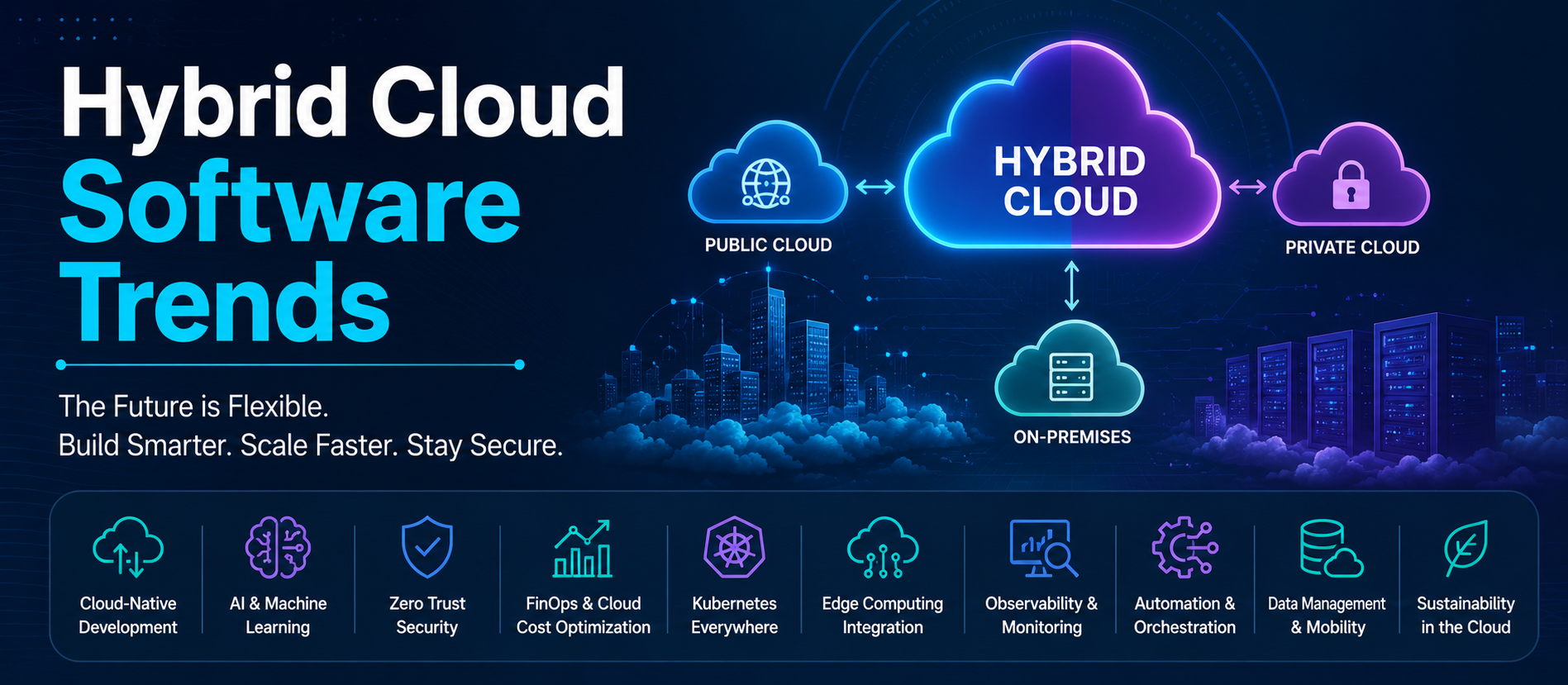
6. Cloud-Native Development Continues to Evolve
7. API-First Development Powers AI and Automation
8. AI-Powered Testing and Quality Assurance
9. Security Moves Earlier in the Development Lifecycle
10. Software Supply Chain Security Gains Attention
11. AI Governance Becomes Part of Software Engineering
💡 Key Insight
Software development in 2026 is changing faster than ever. Artificial intelligence is becoming part of the complete software development lifecycle. AI coding agents are moving beyond simple code suggestions. Platform engineering is becoming more important. Security is shifting earlier in the development process. Cloud-native systems continue to evolve, while businesses demand faster delivery, better governance, and measurable results.
The biggest change is not simply that developers use AI tools. The bigger shift is that software teams are redesigning how applications are planned, built, tested, deployed, monitored, and maintained.
In 2026, successful software organizations focus on one important goal: build faster without losing quality, security, reliability, or control.
This article explains the most important software development trends in 2026 using clear and practical language.
Quick Answer: What Are the Biggest Software Development Trends in 2026?
The biggest software development trends in 2026 include AI-native development, AI coding agents, multi-agent systems, platform engineering, cloud-native development, cybersecurity by design, API-first architecture, intelligent testing, developer experience, and stronger governance for AI-generated software.
Developers are spending less time writing every line of code manually and more time designing systems, reviewing AI output, validating software, and solving complex business problems.
1. AI-Native Software Development Becomes Mainstream
AI-native software development is one of the defining trends of 2026. Traditional software teams added AI tools to existing workflows. AI-native development takes a different approach. It designs workflows, platforms, and applications around the assumption that AI will be involved from the beginning.
AI can now support requirements analysis, code generation, code review, test generation, documentation, debugging, deployment support, and incident analysis.
This does not mean software engineers are becoming unnecessary. Their responsibilities are changing. Developers increasingly focus on system architecture, business logic, security decisions, AI output validation, technical design, integration, and quality assurance.
The future developer is becoming an orchestrator of people, AI systems, tools, and software components.
2. AI Coding Agents Move Beyond Code Completion
Early AI coding tools mainly suggested lines of code. In 2026, AI coding agents can perform larger tasks across the development workflow.
- Understand a software repository.
- Create a development plan.
- Generate multiple files.
- Run tests.
- Identify errors.
- Suggest fixes.
- Create documentation.
- Review pull requests.
This creates a major productivity opportunity, but it also creates new risks. AI-generated code may contain security vulnerabilities, incorrect assumptions, duplicate logic, architecture problems, or performance issues.
For this reason, human review remains essential. The best development teams do not blindly accept AI-generated code. They build review, testing, security scanning, and governance into the workflow.
3. Agentic Software Development and Multi-Agent Systems
A single AI agent can perform a specific task. A multi-agent system uses several specialized agents that work together.
A software development workflow could include a planning agent, coding agent, testing agent, security agent, documentation agent, and deployment agent. Each agent has a defined responsibility while an orchestration layer coordinates the work.
This model can help organizations automate complex workflows. However, more autonomy also creates more governance challenges.
- Define what each agent is allowed to do.
- Control which systems an agent can access.
- Specify when human approval is required.
- Monitor agent actions.
- Create ways to reverse errors.
In 2026, the focus is shifting from simply building agents to building controlled, observable, and secure agent systems.
4. Platform Engineering Becomes More Important
Modern software development involves many tools, cloud services, security systems, databases, APIs, and deployment pipelines. This complexity can slow developers down.
Platform engineering aims to reduce complexity by creating internal platforms that make approved tools and services easier to use.
An internal developer platform may provide:
- Standard application templates.
- Deployment pipelines.
- Security tools.
- Cloud resources.
- Monitoring.
- API access.
- AI development services.
The goal is to improve the developer experience. Instead of every team building infrastructure independently, developers can use standardized and self-service platforms.
Platform engineering is especially important for AI-native development because teams need safe and controlled ways to access AI models, agents, data, and development tools.
5. Developer Experience Becomes a Business Priority
Developer experience, often called DevEx, is becoming a major software engineering priority.
A developer loses productivity when they spend too much time searching for documentation, waiting for environments, requesting infrastructure access, fixing broken development tools, or managing repetitive manual tasks.
A strong developer experience provides:
- Fast environment setup.
- Clear documentation.
- Reliable tools.
- Easy access to approved services.
- Automated workflows.
- Reduced cognitive load.
Companies are increasingly measuring developer productivity by looking at the complete engineering environment rather than simply counting lines of code.
6. Cloud-Native Development Continues to Evolve
Cloud-native development remains an important trend in 2026. Businesses continue to build applications using containers, Kubernetes, microservices, serverless services, and managed cloud platforms.
However, the trend is becoming more practical. Not every application needs a complex microservices architecture. Many teams are learning that unnecessary complexity can increase costs and slow development.
Software architects are increasingly choosing the architecture that fits the business problem. This may include modular monoliths, microservices, event-driven systems, serverless applications, or hybrid architectures.
The key trend is not using the newest architecture. The key trend is reducing unnecessary complexity.
7. API-First Development Powers AI and Automation
APIs are becoming even more important in 2026. Modern software applications need to communicate with AI models, AI agents, cloud services, payment systems, CRMs, databases, and third-party platforms.
API-first development helps organizations build software that is easier to integrate and automate.
Well-designed APIs can support:
- Mobile applications.
- Web applications.
- AI agents.
- Workflow automation.
- Partner integrations.
As businesses deploy more AI systems, clean APIs and well-structured data become essential foundations.
8. AI-Powered Testing and Quality Assurance
Testing is another area changing rapidly. AI tools can help teams generate test cases, identify missing test coverage, create test data, analyze failures, prioritize high-risk code, and suggest regression tests.
AI-powered testing can reduce repetitive work, but it does not eliminate the need for quality engineers.
Human testers remain important for user experience testing, business logic validation, exploratory testing, complex edge cases, and high-risk applications.
In 2026, quality assurance is becoming more continuous and intelligent.
9. Security Moves Earlier in the Development Lifecycle
Security can no longer be treated as the final step before software release.
The DevSecOps approach continues to grow. Security practices are integrated into planning, coding, testing, deployment, and operations.
Modern security workflows may include:
- Automated code scanning.
- Dependency scanning.
- Secrets detection.
- Infrastructure security checks.
- Container scanning.
- Runtime monitoring.
AI-generated code makes security even more important. Development teams must verify that AI-generated code follows secure coding practices and does not introduce hidden vulnerabilities.
The software development trend for 2026 is clear: security must be designed into the system.
10. Software Supply Chain Security Gains Attention
Modern applications depend on many external components. A single application may use open-source libraries, cloud services, APIs, containers, and third-party SDKs.
This creates software supply chain risks.
Organizations are increasing their focus on:
- Dependency management.
- Software inventories.
- Code provenance.
- Secure build pipelines.
- Third-party risk.
Teams need to understand what components are included in their applications and where those components come from.
11. AI Governance Becomes Part of Software Engineering
As AI becomes part of software products and development workflows, governance becomes essential.
Organizations need policies for AI model usage, sensitive data, prompt security, agent permissions, human approval, and output validation.
AI governance is not only a legal or executive responsibility. Software engineers increasingly need to design technical controls into AI-powered applications.
Examples include:
- Access controls.
- Logging.
- Rate limits.
- Human approval steps.
- Monitoring.
- Audit trails.
12. Observability Becomes More Intelligent
Modern applications generate large amounts of operational data. Teams use observability tools to understand application performance, errors, infrastructure health, user activity, and service dependencies.
In 2026, AI is increasingly being used to help teams analyze this information. AI-assisted observability can help identify unusual patterns and possible causes of incidents.
However, teams still need accurate telemetry and well-designed monitoring systems. AI cannot reliably explain an application when the underlying data is incomplete.
13. FinOps and Software Cost Optimization
Cloud computing provides flexibility, but it can also create unpredictable costs. In 2026, engineering teams are working more closely with finance and operations teams to manage cloud spending.
This approach is often called FinOps.
Software teams are focusing on:
- Resource optimization.
- Cloud cost monitoring.
- AI infrastructure costs.
- Unused services.
- Efficient application design.
AI development can add significant computing costs. Organizations therefore need to measure the value created by AI tools and AI-powered software.
14. Low-Code, No-Code, and AI-Assisted Development
Low-code and no-code platforms continue to support faster application development. AI is making these platforms more powerful.
Business users can increasingly describe what they need in natural language, while AI helps generate application interfaces, workflows, database structures, and automation logic.
This does not mean professional software development will disappear. Complex applications still require professional engineers for architecture, security, scalability, integration, and performance.
The biggest change is that software creation is becoming accessible to more people.
15. Smaller Teams Can Build More Software
AI-native development is changing team structures. Small teams can now use AI tools to perform work that previously required more people.
A highly skilled team may combine software engineers, product experts, designers, AI coding agents, and automation systems.
The result can be faster experimentation and shorter development cycles.
However, smaller teams also need strong processes. AI can increase speed, but poor decisions can spread quickly when automation is not controlled.
16. Technical Debt Becomes More Visible
AI can generate code quickly. This creates a risk: organizations may create technical debt faster than before.
Technical debt can result from:
- Poor architecture.
- Duplicate code.
- Weak documentation.
- Unmaintained dependencies.
- Unclear ownership.
In 2026, successful teams are treating technical debt as a business issue. They measure software quality, maintain architecture standards, and review AI-generated code carefully.
The goal is not only to ship software quickly. The goal is to build software that remains maintainable.
17. Human Skills Become More Valuable
AI can generate code, but software development requires more than coding.
Human skills remain essential, including:
- Problem solving.
- System thinking.
- Communication.
- Product understanding.
- Architecture.
- Security judgment.
Developers who understand both technology and business needs will become increasingly valuable.
The future software engineer must know how to work with AI rather than compete with it.
How Businesses Should Prepare for Software Development Trends in 2026
Step 1: Identify Real Business Problems
Start with the problem. Do not start with the technology.
Step 2: Improve the Development Foundation
Strengthen architecture, documentation, APIs, security, testing, and cloud infrastructure.
Step 3: Introduce AI Carefully
Start with useful and measurable development tasks.
Step 4: Build Governance Early
Define access, permissions, human review, and security controls.
Step 5: Measure Results
Track delivery speed, quality, costs, incidents, and developer experience.
Step 6: Train Developers
Engineers need skills in AI, architecture, security, and system design.
SEO, AEO, GEO, and AI Search Optimization for Software Development Content
Software development content should be easy for people and AI systems to understand.
For SEO, use relevant keywords naturally and organize information with meaningful headings.
For AEO, provide direct answers to common questions and explain complex topics in simple language.
For GEO and AI Search optimization, provide clear context. Explain what a technology is, why it matters, where it is used, and what its limitations are.
AI search systems increasingly value content that is structured, factual, readable, and useful.
Frequently Asked Questions
What is the biggest software development trend in 2026?
AI-native software development and AI coding agents are among the biggest trends. AI is increasingly being used across planning, coding, testing, deployment, and software operations.
Will AI replace software developers?
AI is changing software development roles, but developers remain important. Human engineers are needed for architecture, validation, security, business logic, and complex decision-making.
What is agentic software development?
Agentic software development uses AI agents that can perform larger development tasks with different levels of autonomy. These agents may plan, code, test, review, and automate tasks.
Why is platform engineering important?
Platform engineering helps reduce development complexity by providing standardized tools, infrastructure, security controls, and self-service capabilities for developers.
Is cloud-native development still important in 2026?
Yes. Cloud-native development remains important, but teams are increasingly focused on choosing the right architecture instead of automatically using complex systems.
What skills should software developers learn in 2026?
Developers should strengthen skills in AI-assisted development, system architecture, cybersecurity, cloud platforms, APIs, testing, and problem solving.
Conclusion
Software development in 2026 is becoming more intelligent, automated, and AI-driven.
AI-native development and coding agents are changing how software is created. Multi-agent systems are helping organizations automate complex tasks. Platform engineering is reducing developer complexity. Security and governance are becoming essential parts of the development lifecycle.
However, speed alone is not the goal.
The best software organizations in 2026 will combine AI automation with strong architecture, security, testing, human expertise, and governance.
The future of software development belongs to teams that can use AI responsibly while continuing to build reliable, secure, and maintainable applications.
For businesses and professionals interested in software development, artificial intelligence, automation, digital transformation, SEO, AEO, GEO, and AI Search optimization, Digiifrog provides valuable insights for the modern digital world.
Visit www.digiifrog.com to learn more.
Important Note
Software development technologies change rapidly. AI tools, cloud platforms, programming frameworks, security practices, and industry adoption patterns can evolve throughout 2026. Organizations should review current technical documentation and evaluate new technologies based on their specific business, security, and operational requirements.
Ready to Grow?
Talk to us about a strategy tailored to your brand — we will help you stand out in search, AI discovery and social.
Comments (0)
Log in to leave a comment.